

ALICJA KWADE: TELOS TALES AT PACE GALLERY
508 & 510 WEST 25th STREET NEW YORK
May 7, 2025 – August 15, 2025

ALICJA KWADE: TELOS TALES
AT PACE GALLERY
508 & 510 WEST 25th
STREET NEW YORK
May 7, 2025 – August 15,
2025
New York – Pace is
pleased to present Alicja Kwade: Telos Tales, an exhibition of new work by
Alicja Kwade, at its 508 and 510 West 25th Street galleries in New York.
Featuring never-before-seen monumental sculptures alongside new mixed media
works, this marks Kwade’s debut solo show at Pace in New York since the gallery
began representing her in 2023. On view from May 7 to August 15, the exhibition
coincides with this year’s edition of Frieze New York.
Kwade is known
internationally for sculptures, large-scale public installations, films,
photographs, and works on paper that engage poetically and critically with
scientific and philosophical concepts. Through a distinctive vocabulary
encompassing reflection, repetition, and the manipulation of everyday objects
and natural materials, the artist raises questions about structures and systems
that govern and shape our daily lives. In her contemplative works, which
dismantle boundaries of perception, she challenges commonly accepted ideas and
beliefs while proposing new modes of seeing and understanding reality.
Kwade’s work is
represented in the collections of the Los Angeles County Museum of Art, the
Hirshhorn Museum and Sculpture Garden in Washington, D.C., the Centre Georges
Pompidou in Paris, the Neue Nationalgalerie in Berlin, the National Gallery of
Australia in Canberra, mumok – Museum Moderner Kunst Stiftung Ludwig in Vienna,
and the Yuz Museum in Shanghai, among other international institutions. Her
public sculptures can also be found around the world—at Stanford University in
Palo Alto, California and MIT in Cambridge, Massachusetts as well as sites in
Germany, Italy, Sweden, and other countries. Her practice is part of a lineage
of pioneering 20th century abstractionists within Pace’s program, including
Louise Nevelson—who shaped what would come to be known as installation art with
her iconic sculptural “environments”—and Agnes Martin, whose work was exhibited
alongside Kwade’s in a two-artist exhibition at the gallery’s Los Angeles space
in 2024.
At the center of Alicja
Kwade: Telos Tales are three large-scale sculptures in which powder-coated
steel frames gradually transform into amorphous, tree-like bronze forms. The
architectural, linear structures slowly dissolve into organic shapes, as if one
material is evolving into the other. The sculptures unfold into a distinct,
self-contained configuration—complete in itself, yet intrinsically connected to
a larger conceptual framework. Each work is named for a concept from
Aristotle’s fourfold theory of causes: Causa Materialis, Causa Efficiens, and
Causa Formalis. The fourth cause, Causa Finalis—the purpose, or telos—remains
unnamed but not unconsidered: it is implicit in the exhibition’s title.
Another work, PhaseChase,
explores the intangible nature of time. This piece consists of a highly
polished stainless steel pipe suspended from the ceiling. Embedded within the
pipe is a double-sided clock face, mirrored from within to create a
multiplication of reflections that appear to dissolve into a curved, reflective
surface.
Though distinct in form
and concept, these works engage in a dynamic dialogue. Material and time
intersect, literally and conceptually, generating a space in which perception,
causality, and temporality become intertwined.
In this immersive
exhibition, Kwade deepens her long-standing interest in time as a structuring
principle of perception, reality, and causality. Her works reflect on the
cyclical, linear, and ultimately elusive nature of temporal experience and its
interdependence on both natural and constructed systems—an ongoing theme in her
practice. This presentation showcases new developments in Kwade’s engagement
with material, form, and concept, and it exemplifies the experimental spirit
that has defined her work from the very beginning of her career.
Kwade’s exhibition at
Pace in New York will follow her first solo institutional presentation in Hong
Kong, which was presented this year at Tai Kwun. In the fall, the artist will
mount a solo exhibition at M Leuven in Belgium.
https://www.pacegallery.com/exhibitions/alicja-kwade-telos-tales/


TELOS TALES,
2025
Stainless
Steel, Powder Coated Stainless Steel,
Patinated
Bronze, Clock and sSound Installation
Dimensions
Variable
© Pace Gallery


CAUSA
FORMALIS, 2025
Patinated
Bronze, Powder Coated Stainless Steel
Dimensions:
447.9 cm × 909.6 cm × 574.2 cm
© Pace Gallery


SUNDERSTATE
VI, 2025
Polished
Glass, Clock, Patinated Bronze
Dimensions:
65.7 cm × 30 cm
© Pace Gallery


SUNDERSTATE
VIII, 2025
Polished
Glass, Clock, Patinated Bronze
Dimensions:
70.8 cm × 60 cm
© Pace Gallery


ALICJA KWADE
STUDIO
Polished
Glass, Clock, Patinated Bronze
Dimensions:
70.8 cm × 60 cm
© Pace Gallery


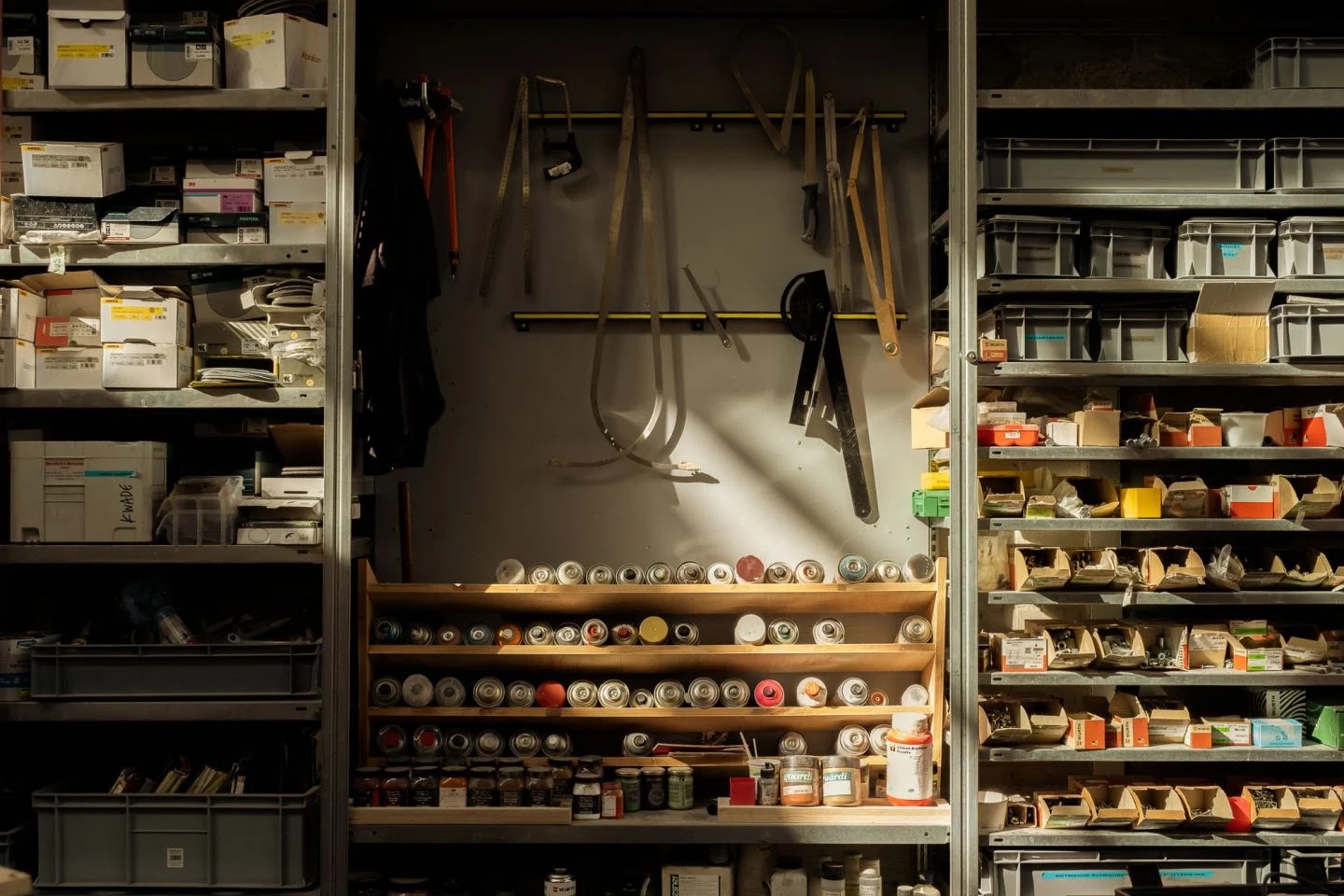


ALICJA KWADE
STUDIO


ALICJA
KWADE TELOS TALES
In Telos Tales,
Alicja Kwade composes an environment in which philosophical inquiry is
crystallized as sculpture. Kwade’s new works extend her longstanding
exploration of time, nature, and perception by orchestrating our embodied
experience of materiality, reflection, and void. The environment she has
constructed, in which architectonic structures seem locked in an arrested
metamorphosis—transforming from open, rectilinear bronze forms into gnarled
tree branches whose patinated surfaces suggest lichen—raises foundational and
often deeply metaphysical questions. Her work engages the classic philosophical
question of whether we complete nature or merely replicate it—investigating the
porous border between what we create and what, in turn, creates us.
The crux of Kwade’s
questioning revolves around both the concept and the everyday experience of
time. Folding space and substance into an architecture of perceptual
dislocation, Kwade draws on Immanuel Kant’s idea that time is not an external
constant—not some “thing” out there in the world—but rather an inner framework,
a subjective “inner clock.” Through a strange tension between fact and
illusion, Kwade literalizes time’s interiority through the form of the tube. We
move through time, yet we never truly experience it; we are always in a
perpetual "now,” a kind of “inner tube” suspended in the inexorable
unfolding of events.
Kwade has long used
clocks as elements in her practice, harnessing the image of the clock for all
its cultural references, but also utilizing its everyday function as sculptural
material. In Telos Tales, this forest of metamorphosing steel structures is interwoven
with discrete sculptures consisting of long, stainless-steel tubes embedded
with working clocks. These works function like spatial riddles. They evoke
inner organs or conduits, suggesting that time is not just something we move
through, but something we are made of—and that we participate in making through
the activity of thought and perception. “All the clocks display the same
seemingly significant now-time, and they do so in a strikingly insistent way:
their perfectly synchronized ticking is audible throughout the space, and all
three show exactly the same quasi-now at once.” Yet the “now” that they
represent is always already an illusion; by the time we register it, it has
already slipped away.
As one moves through the
gallery, the reflections of the clock on the concave inner surfaces of the
tube—and the distorted images of the surrounding environment on its
exterior—ripple and shift, registering our own bodily presence. Two kinds of
movement intersect: the movement of the hand of the clock, and the shifting
reflections of both exterior and interior space. “The reflection inside is
about time as movement,” Kwade explains. Space is segmented into dual realms,
inner and outer, mirrored and distorted, echoing the way our own embodiment
divides objective reality from our own inner perceptions through the threshold
of the senses. This dreamlike warping effect created through the play of
reflection and metamorphosis suggests a surreal unbinding of the temporal
fixities that would otherwise be associated with the authority of the clock.
Kwade’s engagement with
the notion of telos harkens back to Aristotle, who understood it as a concept
of intrinsic purpose—an endpoint already embedded in all beginnings. In
Aristotle’s thought, telos is not simply an end; it is the seed, a hidden
future nestled in the origin of everything. The titles of the patinated bronze
sculptures, which are half-organic and half-industrial, are drawn from
Aristotle’s own categories: Causa Materialis, Causa Efficiens, and Causa
Formalis. These terms respectively refer to the raw matter to be shaped, the
effect that brings about the end result of that shaping, and the shape of
matter itself as form. This engagement with the ontology of matter undergirds
Kwade’s efforts not to imitate nature but to complete it, to extend it, to give
it “another turn.” In this way, her sculptures hover between architecture,
engineering, and organic form—they are as much “grown” as they are forged. They
are not defined by a category but exist in between, like strange creatures
half-grown in logic, half-born from myth.
There is also a mystical
and haunting quality to Kwade’s environment, which suggests another notion of
time: the passing away of organic life and the memories it leaves in the form
of residues and revenants. The tree branches that Kwade used to cast the bronze
forms were collected from discarded matter on the streets of Berlin, traces of
urban planning. Kwade gathered them while working together with local municipal
gardening authorities who were responsible for their removal. “They are,” says
Kwade, “the wild and dead ends of urban park, garden, and forest planning.” The
resulting works are marked by the history of their former lives as trees. In
the gallery space, they appear almost sentient—their branches twisting like sea
monsters, suggesting the surreal hallucinations of a forest at night, the
shapes the mind projects onto chaos. This “inner picture” we cast onto the
external world is materialized through Kwade’s fusion and confusion of natural
and artificial. Her forms are machines of memory and bodies of wonder. They
suggest an inner monster of instinct and affect wrapped in a skeleton of
mathematics and precision.
Memory itself becomes an
active presence in Kwade’s work. What happens to the world, to objects, when we
try to remember them? What happens to time when we try to pin it down? Kwade’s
sculptures feel like memory’s scaffolding, the bones of things lost or yet to
be. They carry a dystopian undertone—a quiet reckoning with what we are leaving
behind, and an ominous attempt to reconstruct nature in our own distorted
image.
Telos Tales is a
meditation on the human condition: to be embodied in time and space, to
navigate the tension between the affective and the metaphysical, the instinctual
and the constructed. The works pulse with contradiction—unsettling and serene,
logical and wild, fixed and fluid. In places, they seem to struggle, merge, or
transform. The result is not resolution but resonance—a space where philosophy
is sculpted into form and time itself is given shape.
Oliver Shulz
https://alicjakwade.com/exhibitions/telos-tales

PHASECHASE,
2025
Stainless
Steel, Clock, Sound Installation
Dimensions: 198
cm × 102 cm
© Pace Gallery


WHAT PART OF
ME DON’T YOU KNOW, 2023
Paper, Glass,
Marble, Brass
Dimensions:
254 cm × 80 cm × 80 cm
© Pace Gallery


ALICJA KWADE
Alicja Kwade (b. 1979,
Katowice, Poland) investigates and questions universally accepted notions of
space, time, science, and philosophy by breaking down frames of perception in
her work. Kwade’s multifaceted practice spans sculpture, installation, video,
and photography. She utilizes quotidian and found objects such as rocks,
mirrors, lamps, and clocks to explore profound ideas about the fabric of
reality. Kwade’s use of elements such as copper, iron, human-made plastics, and
recycled materials reflects her interest in both physics and chemistry, using
art to bring core concepts together and examine the phenomena of the physical
world.
Her works often utilize
the alchemical properties of her chosen materials to reveal the nature of the
systems we use to understand the world— such as those for marking time or
uncovering the origins of the universe—distilling complex ideas through form,
material, and composition. Through her practice, Kwade examines planetary
systems, molecular compositions, and mathematical frameworks, challenging
conventional modes of thinking and exploring both the physical and
metaphysical. While her work is often associated with Minimalism, Kwade
approaches her practice with an eye toward Conceptual art.
Important exhibitions of
Kwade’s work include Alicja Kwade: Von Explosionen zu Ikonen Piepenbrock
Förderpreis für Skulptur 2008 WerkRaum. 25, Hamburger Bahnhof, Museum für
Gegenwart, Berlin (2008); Alicja Kwade: Probleme massereicher Körper,
Westfälischer Kunstverein, Münster, Germany (2010); Alicja Kwade: Warten auf
Gegenwart, Kunstmuseum St. Gallen, Switzerland (2014), which traveled to
Kunsthalle Nürnberg, Germany (2015); Alicja Kwade: Monolog aus dem 11ten Stock,
Haus am Waldsee, Berlin (2015); Perception is Reality - Über die Abbildung von
Wirklichkeit und Virtuellen Welten, Frankfurter Kunstverein, Germany (2017);
Alicja Kwade: Out of Ousia, Kunsthal Charlottenborg, Copenhagen (2018); Alicja
Kwade: “Being...”, Neuer Berliner Kunstverein, Berlin (2018); Alicja Kwade:
LinienLand, Museum Haus Konstruktiv, Zurich (2018); Alicja Kwade:
Kausalkonsequenz, Langen Foundation, Neuss, Germany (2020); Alicja Kwade: In
Abwesenheit / In Absence, Berlinische Galerie – Landesmuseum für Moderne Kunst,
Berlin (2021); Alicja Kwade: Au Cours Des Mondes, Place Vendome, Paris (2022);
Alicja Kwade: In Agnosie, Lehmbruck Museum, Duisburg, Germany (2023–24); Alicja
Kwade, Museum Voorlinden, Wassenaar, the Netherlands (2024); and Alicja Kwade:
Pretopia, Tai Kwun Contemporary, Hong Kong (2025). In 2017, she participated in
Viva Arte Viva, curated by Christine Macel at the 57th Venice Biennale. In
2019, The Metropolitan Museum of Art commissioned her to create ParaPivot,
which was on view at the roof garden through October of that year. Her work is
held in numerous public collections worldwide, including Centre Georges
Pompidou, Paris; Kunsthalle Mannheim, Germany; Los Angeles County Museum of
Art; Louisiana Museum of Modern Art, Humlebæk, Denmark; and Wroclaw
Contemporary Museum, Poland. Kwade lives and works in Berlin.


PACE GALLERY
Pace is a leading
international art gallery representing some of the most influential artists and
estates of the 20th and 21st centuries, founded by Arne Glimcher in 1960.
Holding decades-long relationships with Alexander Calder, Jean Dubuffet, Agnes
Martin, Louise Nevelson, and Mark Rothko, Pace has a unique history that can be
traced to its early support of artists central to the Abstract Expressionist
and Light and Space movements. Now in its seventh decade, the gallery continues
to nurture its longstanding relationships with its legacy artists and estates
while also making an investment in the careers of contemporary artists,
including Torkwase Dyson, Loie Hollowell, Robert Nava, Adam Pendleton, and
Marina Perez Simão. Under the current leadership of CEO Marc Glimcher and
President Samanthe Rubell, Pace has established itself as a collaborative force
in the art world, partnering with other galleries and nonprofit organizations
around the world in recent years. The gallery advances its mission to support
its artists and share their visionary work with audiences and collectors around
the world through a robust global program anchored by its exhibitions of both
20th century and contemporary art and scholarly projects from its imprint Pace
Publishing, which produces books introducing new voices to the art historical
canon. This artist-first ethos also extends to public installations,
philanthropic events, performances, and other interdisciplinary programming
presented by Pace. Today, Pace has nine locations worldwide, including two
galleries in New York—its eight-story headquarters at 540 West 25th Street and
an adjacent 8,000-square-foot exhibition space at 510 West 25th Street. The
gallery’s history in the New York art world dates to 1963, when it opened its
first space in the city on East 57th Street. A champion of Light and Space
artists, Pace has also been active in California for some 60 years, opening its
West Coast flagship in Los Angeles in 2022. It maintains European footholds in
London and Geneva as well as Berlin, where it established an office in 2023 and
a gallery space in 2025. Pace was one of the first international galleries to
have a major presence in Asia, where it has been active since 2008, the year it
first opened in Beijing’s vibrant 798 Art District. It now operates galleries
in Hong Kong and Seoul and opened its first gallery in Japan in Tokyo’s
Azabudai Hills development in 2024.

.png)