


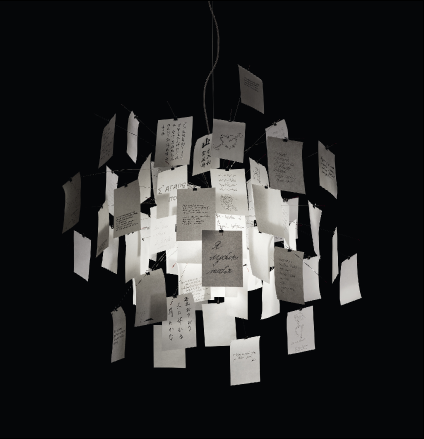
ZETTELITE DESIGN BY INGO
MAURER 1997
I am sure that many
people go around with ideas for a long long time. Some will be realized,
others just vanish. Zettelite is such an idea, which was on my mind
for almost twenty years. The word ‘Zettel’ in German means scrap of paper.
Is it necessary to explain the name I gave, why I baptized it Zettelite?
Paper has always been my
favourite material in combination with light, but for a long time paper
was ‘out’. My early paper lamps were no great success, when I showed them
in the Seventies. Nowadays, they are. Think of Willydilly,
Lampampe, Floatation, Knitterling etc. Yes, paper was out for a long time
and since quite a few years it is back on the market but most of these
products are very poorly done. Noguchi is still the best.
Light passing through
paper is the idea behind Zettelite, in combination with poems, messages –
maybe to the beloved one -,sketches, children’s drawings, sexy
pictures, mysterious riddles, recipes or maybe just ‘Forgive me, darling,
for my bad behaviour’, personal documents. Think of a beautiful
calligraphy, in Japanese, Arab or Chinese. Zettelite is a product, clear
in its concept and once again free for the user to make of it what he
wants, but always creating a pleasant light, soft for the eyes. And a
mild light makes people always better looking. A strong, hidden light
source shoots the light for instance on a table and creates a very
pleasant dining atmosphere.
Extremely easy to
assemble, very economically packed and a ‘cash-and-carry’ item, with a
flair of arte povera, and maybe a slight feeling of Dada. The judge is you!
The scraps of paper move
with the slightest wind, but altered strong paper clips keep them from
falling and little red plastic tips prevent injuries. A kind of Yin and
Yang solution, Yin for the softness and the female, and Yang for the
strength and the male. Is it really like that, or is it just the other way
around?
* name changed to
Zettel’z 5 / Zettel’z 6 later
Ingo Maurer
www.ingo-maurer.com
You may reach to see Ingo
Maurer's another project of Kruisheren Hotel Maastricht to click below link.
http://mymagicalattic.blogspot.com.tr/2013/12/ingo-maurer-kruisherenhotel-maastricht.html

BANGBOOM! ZETTEL’Z DESIGN
BY INGO MAURER
Japanese paper, stainless
steel, heat-resitant satin-frosted glass. 80 printed paper sheets DIN A5.
Drawings by Thilo Rothacker. 230/125 volts, max. 250 watts, E27, max. 75 watts PAR
30 Halogen 30°, E27. Complete with bulbs. BangBoom! Zettel‘z is a
new, limited edition of Zettel‘z 5.


ZETTEL’Z 5 DESIGN BY INGO
MAURER 1997
Stainless steel,
heat-resistant satin-frosted glass, Japanese paper. Halogen Halolux ceram
clear, 230/ 125 volts, max. 250 watts, socket E27 (top), halogen PAR 30,
max. 75 watts, 30°, socket E27 (bottom), canopy diameter 11 cm. Cable
length 330 cm. 31 printed and 49 blank paper sheets DIN A5. Complete with
bulbs. Replacement set of 80 blank paper sheets available.
http://www.ingo-maurer.com/en/products/zettelz-5



ZETTEL’Z VIVA L’ITALIA
DESIGN BY INGO MAURER
Gestaltung: Ingo Maurer undTeam 2011 Japanese paper, stainless steel, heat-resistant satin-frosted glass. 80 printed paper sheets DIN A5. 230/125 volts, max. 250 watts, E27 and max. 75 watts PAR 30 Halogen 30°, E27. Cable length 330 cm. Complete with bulbs. Zettel‘z Viva l'Italia is a new, limited edition of Zettel‘z 5.
http://www.ingo-maurer.com/en/products/zettelz-viva-litalia


ZETTEL’Z 6 DESIGN BY INGO
MAURER 1998
Stainless steel,
heat-resistant satin-frosted glass, Japanese paper. Halogen Halolux ceram
clear, 230/125 volts, max. 250 watts, socket E27, canopy diameter 11
cm. Cable length 200 cm. 40 printed and 40 blank paper sheets DIN A6.
Complete with bulb. Replacement set of 80 blank paper sheets available.
http://www.ingo-maurer.com/en/products/zettelz-6


‘’ The quality of light
is more important to me than its form. ‘’
Ingo Maurer


INGO MAURER
Born in 1932 on the
island of Reichenau in Lake Constance, Germany, Ingo Maurer trained as a
typographer and subsequently studied graphic design in Switzerland and in
Munich. In 1960 he moved to the USA, where he worked as a designer for various
clients including IBM. In 1966, having returned to Germany three
years previously, he set up his own company, Design M, in Munich, to make
and market his own designs, the first of which was the celebrated
"Bulb", a Pop Art lamp within a lamp.
In the 1960s and 1970s Maurer
made a name for himself with unusual designs and appearances at trade
fairs. "Bulb" won a place in the MoMA design collection as early
as 1969. The naked light bulb is a continually recurring motif: in homage to
its inventor, Thomas Alva Edison, Maurer used the name Edison in several
of his own products. His first commercial success came with the series of
fan lamps, incorporating traditional Japanese fan designs, which he
started to produce in the early 1970s, after visiting Japan several times
to meet the fan-makers and watch them at work. In 1977 Maurer also began
to use thin Japanese paper - a material which has continued to intrigue
him and still features prominently in his collection. At the 1984 Euroluce
fair in Milan, Maurer presented the pioneering low-voltage lighting system
YaYaHo. The system, which had taken some two years to develop, consisted
of low-voltage cables stretched across a room, with a variety of
movable halogen elements which could be positioned according to the user's
preferences. At that time, the interior use of halogen bulbs, which made
safe lighting with exposed cables possible, was almost unheard-of. YaYaHo
was rapturously received by the interior design industry, especially in
Italy and France, and has since had countless imitators.
In 1989 the Fondation
Cartier pour l'Art Contemporain in Jouy-en-Josas near Paris staged the
exhibition Ingo Maurer: Lumière Hasard Réflexion, which gave the designer his
first opportunity to create lighting installations of a non-commercial nature.
In the same year he also had a retrospective in the city then known as
Leningrad. Since then, his designs - whether one-off commissions or
mass-produced lamps from his ordinary collection - have been shown all over the
world in many exhibitions, including the one-man shows Ingo Maurer: Working
with Light in the Villa Stuck in Munich (1992) and Licht licht at
the Stedelijk Museum in Amsterdam (1993).
In 2002 the Vitra Design
Museum, in cooperation with Maurer, organised the travelling exhibition
Ingo Maurer - Light - Reaching for the Moon,
which was shown in several cities in Europe and Japan. Another important
exhibition of Maurer's work was Provoking Magic: Lighting of Ingo Maurer, at
the Cooper-Hewitt National Design Museum in New York. Recently, the
Bauhaus Archiv Berlin has shown a representative selection of his works.
Maurer's best-known
designs include "One From The Heart" (1989), incorporating a red
plastic heart; the winged light bulb "Lucellino" (1992) and the
various other members of its feathered family; and "Porca
Miseria" (1994), a pendant made of broken crockery. Since the
mid-1990s Maurer has increasingly been exploiting the unique aesthetic
effects of LEDs and technical components such as printed circuit boards.
An example of this is "Einstein", a large pendant which combines the
image of the light bulb with green circuit boards and multicoloured LEDs.
In 1990, Maurer began to
devote a significant part of his energies to planning installations and
lighting systems for a wide range of public and private clients,
in addition to making lamps for the collection of his firm, now known as
Ingo Maurer GmbH. Some examples of these special commissions are the giant
aluminium lampshades for the Westfriedhof underground station in Munich
(1998); an installation for a show by the Japanese fashion designer Issey
Miyake (1999); the light sculptures for the interior of the Atomium in
Brussels; and a large-format light object for the Rockhal in Luxembourg
(2007) and the lighting and colour design for another subway station in
Munich, Münchner Freiheit. Maurer lives in Munich, where his firm, which
now employs over 60 people, also is located. In 2008, he opened a 700 sqm
showroom at 47 Kaiserstrasse, Munich in a former production and storage
hall, which is in the same building as his office and studio space. In
2010 Ingo Maurer received the Design Award of the Federal Republic of
Germany.

.png)
