

LA CITE DU VIN: WINE MUSEUM IN BORDEAUX DESIGN BY XTU ARCHITECTURE

AUDACIOUS CONTEMPORARY
ARCHITECTURE BY XTU
The architecture and
scenic design of La Cité du Vin are the fruit of a close partnership between
two firms: Parisian architects XTU and English museum design experts Casson
Mann. Their project – which combines a bold, poetic interpretation of the
spirit and intangible cultural power of wine with a raft of immersive digital
technologies – wowed the judging panel during the call for tenders launched by
commissioning authority the City of Bordeaux in late 2010. This tender
procedure required candidates to form architect-designer partnerships to ensure
that the structure and its content were part of a single, cohesive project. A
total of 114 submissions were received, 5 projects were short-listed and 1
winner was ultimately chosen: XTU and Casson Mann, in association with Canadian
engineering form SNC Lavalin. GTM Bâtiment Aquitaine, a subsidiary of Vinci
Construction France, was then selected as the project’s designated construction
partner.
AUDACIOUS CONTEMPORARY
ARCHITECTURE
The architects from
Parisian agency XTU, Anouk Legendre and Nicolas Desmazières, have imagined a
structure replete with symbolic echoes: the swirl of wine moving in a glass,
the coiled movement of a grapevine, the ebb and flow of the Garonne... Their
design captures the spirit of wine and its fluid essence: ‘a seamless curve,
intangible and sensual’ (XTU Architects) which addresses its multiple
environment. Horizontal and vertical lines are linked in a unique continuous
motion growing out of the soil along a large boardwalk ramp. More a movement
than a shape, it releases and reveals itself as it rises, creating an event
amid the landscape that connects with the bridge and river.
AN INNER ‘ SOUL ‘
This curve, matching the
curve of the Garonne, is also reflected in the interior volumes, spaces and
materials. La Cité du Vin houses a major space in the shape of the permanent
tour on the second floor, an immersive voyage of discovery into the world of
wine. It winds around a central courtyard, allowing visitors to enjoy a flowing
visit to the full. The area is framed by a spectacular and immersive wooden
structure: 574 curving arches, all individually made, constructed of laminated
timber. These wooden arches continue up the tower to the belvedere level in 128
spines, culminating at a height of 55 metres and tying the whole space together
by interlacing the different floors. They accompany the visitor’s path at
different levels, emerging on the outside of the building as they rise up the
tower. The iconic indoor spaces all have their own particular identities, from
the Thomas Jefferson Auditorium with its ceiling of suspended wooden tubes and
the belvedere with its mirrored bottle ceiling to the immersive multi-sensory
room with its curved glass walls printed with large wine-based designs.
A CONSTANTLY CHANGING
APPEARANCE
Once fully grown, La Cité
du Vin will be a dazzling display of golden reflections, reminiscent of the
white stone of Bordeaux facades and in dialogue with the lights of the Garonne.
This design and the twists it incorporates capture a fluid essence. Its outer
structure consists of custom-printed glass panels (both flat and curved) in a
variety of colours, and lacquered, iridescent aluminium panels in a single
colour. The different, constantly changing shades and angles of these panels
give the building an appearance which develops with the Bordeaux sky:
reflections of the clouds, the city and the water enhance La Cité du Vin’s
evocative appearance. Set a distance away from the structure, this shell offers
shade from the sun and effective thermal protection.
Innovative tools to
achieve an aim
The XTU agency’s use of
innovative design tools to develop the geometry and complex shell helped to
perfectly capture the architects’ mental image of La Cité du Vin and transform
it into a sensational project.
https://www.laciteduvin.com/en?gclid=Cj0KCQjwxvbdBRC0ARIsAKmec9apKto_MeUwCKiu4C_x00QY8TMG46crd8_OmMmqDXEICG0Dr1hE3jgaAr5tEALw_wcB






THE PERMANENT TOUR
VÉRONIQUE LEMOINE
Director of the permanent
tour of
the Fondation pour la
culture et les civilisations du Vin
At the heart of the
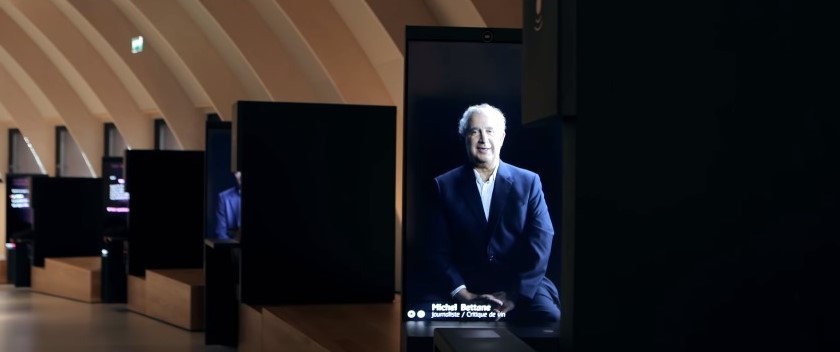
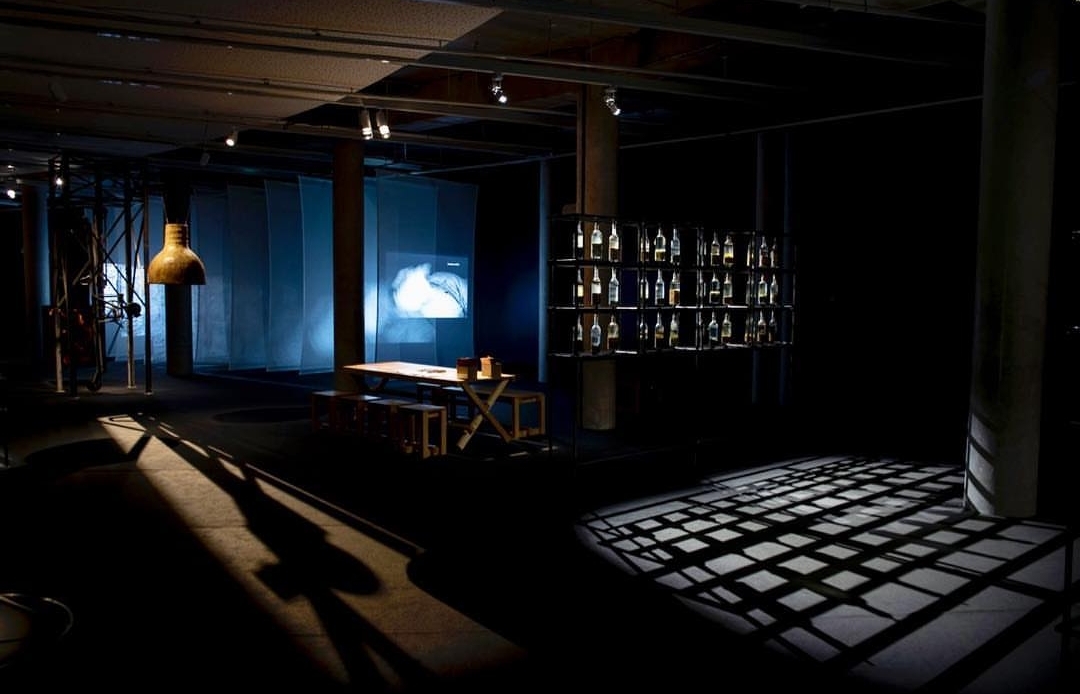
visitor experience and the identity of La Cité du Vin, the immersive,
multi-sensory permanent tour occupies some 3,000 m² and features 19 different
themed spaces, the majority of which are interactive. Visitors are free to
wander around the exhibition space as they see fit, with no fixed, compulsory
route. The permanent tour is an invitation to a voyage of discovery, a journey
through time and space exploring the evolution of wine and its civilisations.
Young and old alike will get to grips with the very rich imaginary world of
wine and how it has affected the societies and regions of the globe for
millennia, from 6,000 BC to the present day. From legends, terroirs and
landscapes to graphic arts, architecture and literature, the culture of wine is
an extraordinary epic which has inspired and shaped the lives of humans for
centuries.
The permanent tour allows the visitor to wander freely. Visitors can browse around at will, depending on their interests and the time at their disposal. As a participant or a spectator, sitting or standing, they can alternate between experiences which may be individual, collective, informative, fantasy or multi-sensory. Everyone is free to organise their own individual visit.
Visitors are joined on
this odyssey by their personal handheld guide, connected to an innovative
device which detects the wearer’s position within the exhibition space and sets
of the appropriate multimedia content. The digital guide delivers the
explanatory dialogue in real time in the user’s selected language (8 languages
available), ensuring that as much of the material as possible is available to
visitors with (visual, auditory or cognitive) disabilities. The guide also
features a specially-designed programme for younger visitors. Visitors can also
use the personal digital guide to highlight their favourite moments in the
exhibition experience, and at the end of their visit they will be presented
with a personalised information booklet filled with opportunities to learn more
about their chosen subjects.


CHATEAU
MARGAUX


CHATEAU MARGAUX
PRUNING
Pruning is essential.
That is what the production quality and the longevity of the plots depends on.
Indeed, the number of buds per plant determines the delicate balance of the
vigour; pruning that leaves too many buds leads to a harvest that is too
abundant and unable to ripen sufficiently. Conversely, pruning that is too
severe leaves vines that are too vigorous, encouraging excessive growth to the
detriment of the maturity of the grapes.
There is, not only for each plot, but for each grape variety, an optimal
balance that only winegrowers understand with experience.
Winter pruning extends into the spring by a green pruning and bud-thinning.
This means avoiding a build-up of vegetation that is harmful to the exposure of
future grape clusters to the sun and as well to concentrating the nutrients
produced by the leaves towards the branches that support the grapes, which
encourages ripening. Lastly, bud-thinning enables the winegrowers to select
future branches for thinning in advance.
PLANTING
Great wines are always
produced from vines that are at least twenty years old. So the main objective
of our wine-growing practices is to maintain the old vines in production for as
long as possible. But their life expectancy doesn’t always fulfill our hopes...
In particular, the Cabernet Sauvignon variety, the heart of our vineyard and
the soul of our wine, has a very high mortality rate.
The main solution is to replace the plants, one by one, as and when they die.
This is called “complantation”. This practice, as old as the vineyard, occupies
all our winegrowers for two months just after the winter pruning. We replace
between 10,000 and 15,000 plants per year! But it’s only at the price of this
lengthy work that we’re able to maintain the high density of planting in our
plots (10,000 plants per hectare); this allows the harmonious management of the
vigour of the vines.
The complants themselves have a limited life expectancy... At the end of the
day, it’s the whole plot that expires. So we then have to carry out a complete
renewal. What a sacrifice! First, we have to pull up all the vine stocks and
then let the soil rest for six years. Finally, we replant it and wait until
these new vines grow and age in order to produce great wine.
FROSTS
Among all the risks that
are the farmers’ lot in life, frost and hail are the two most terrible and
unfair. In just a few minutes they can reduce to nothing a whole year, or even
several years’ efforts. But by some sort of miracle, the great terroirs more
often than not, escape these misfortunes. Hail is almost unknown at Château
Margaux.
Why ? We really don’t know. On the one hand, if frost misses the greater part
of our vineyard, it’s thanks to its particular situation, close to the river
where the thermal inertia protects its surroundings from the cold and is
sufficiently elevated to escape the accumulation of masses of icy air. Every
rule has its exceptions… our white plot presents such a sensitivity to spring
frosts that we decided, as of 1983, to install an anti-frost system. The
principle is simple: we spray the vines with water for as long as the frost
lasts, generally until dawn. The heat produced by the formation of ice enables
the maintenance of the temperature above the limit below which the vegetation
is destroyed. Before starting the sprinklers, we have to take into account the
temperature, the wind and the air humidity, and all this at three o’clock in
the morning! When the decision has been taken, in spite of fatigue, it’s a huge
consolation to save the harvest and to be present at the fairy-like show given
by the ice as it forms around the buds.

PLOUGHING
We intentionally keep the
work of the land traditional, although a great part of it is carried out by
high-clearance tractors and equipment that is of ever-increasing efficiency.
Our four ways of ploughing: surfacing and desurfacing, surfacing, desurfacing
rhythmically throughout the farming year is done in an almost unchanging way.
It’s true that our soils, generally light and well-structured thanks to regular
addition of manure, lend themselves well to this superficial work.
More strangely perhaps, we continue, twice per year, to remove the “cavaillons”
by hand. This consists of loosening the coating of soil left around the vine
stocks by the ploughs.
Our interest in research doesn’t only apply to new techniques, but also the
old, traditional ones. For that reason, we are currently conducting some
ploughing experiments with a horse. We would like to be able to draw on years
of experience before returning to that method of ploughing, should that be the
case.
PROTECTION OF THE VINES
Obtaining grapes that are
ripe enough presupposes a perfect control of the phyto-sanitary condition of
the vineyard. During the last thirty years, the quality of treatment products,
their efficiency and their ease of use, hasn’t stopped improving. The power and
precision of the new spraying equipment have also contributed a great deal to
this success.
Mildew, powdery mildew, black-rot, excoriation, almost all fungal diseases,
with the notable exception of the wood diseases, esca and eutypiose, that
particularly affect the Cabernet Sauvignon variety, are now well controlled.
Powdery mildew is controlled by sulphur and mildew by spraying copper sulphate,
the famous “Bordeaux mixture”.
The case of grey rot (Botrytis cinerea) is certainly more
delicate, but the low instance of vigour in our vines and their traditional
behaviour create rather unfavourable conditions for the development of this
disease.
The problem presented by parasites, insects and spiders is complex in a different
way. In the nineteen eighties we questioned all of our vineyard protection
policy with the objective of finding an alternative method to chemicals to
preserve the balance of the spider and insect populations. After a few years of
work, we were able to stabilise the situation. Since then, all these
populations cohabit and autoregulate themselves without us having to take any
action, or only in an organic way. At the end of the nineteen nineties, sexual
confusion was developed in order to stop the grape worms reproducing. Not one
insecticide is now used in our vineyards.
THINNING
In 1986, Château Margaux was the first vineyard in the Médoc to practise
thinning, which consists of removing a certain number of clusters before the
start of the ripening period. In most of the young vines, the harvest in
practice is too abundant to produce a quality wine; by reducing them at their
mid-term, that is to say just before they change colour about the beginning of
August, we encourage the ripening of the other clusters left on the vine,
without increasing the vigour of the plant.
This technique also
allows us to select the best clusters and to eliminate those that are badly
placed on the vine, or that are already late compared to the others. It is work
that is really meticulous and differs for each vine, grape by grape, which
gives a good idea of the increasingly precise and rigorous attention given to
the care of the vineyard.


YIELD
The yield from the vines,
expressed by their production (kilos of grapes or hectolitres of wine) is a key
factor in the quality of the grapes. Too abundant a harvest never ripens
because the vines become exhausted for no other reason than trying to feed too
many clusters at once. In order to protect the quality of the wine and the
longevity of the vines, the Margaux appellation has fixed a limit that is in
general the most restrictive in the Médoc.
TRELLISING
The very high density of
the plantation in our vineyard (10,000 plants per hectare) would lead very
quickly to an impossible tangling of the branches if we didn’t provide a good
trellising. Primary objectives are to allow free circulation between the rows,
on foot or by tractor, and to maximize the exposure of the clusters to the sun,
a factor so necessary to their optimal ripening.
The trellising consists of two successive steps: first, lifting of the
branches. That is done thanks to a set of mobile wires that we pick up as and
when the vine grows. Then the cutting, or “topping”, of the tips of the
branches, carried out mechanically by a piece of equipment on the overhead
clearance tractors.
RIPENING
The acquisition of the
grapes in a perfect state of ripeness is the precondition for producing a great
wine; consequently, all our winegrowing practices are directed toward this
objective. But by far and away the most important factor is the terroir: it’s
their aptitude to enable the wine varietal to ripen well that distinguishes the
greatest growths. To enable a grape to ripen “well” is to ensure that its
components, that is to say sugar, acidity, aromas and tannins, evolve together
at the same pace. In the Bordeaux region, we’re lucky enough to enjoy a
temperate climate and a moderately rich soil, allowing the vines to accompany
the grapes in this effort to create the perfect balance.
MANURE
The objective of manure
is to bring to the vine the nutrition that it needs, without excess that would
increase the vigour to the detriment of the quality and in respect to the
environment.
A manuring process known as “deep manuring” can also sometimes be applied as a
preamble to a new plantation. Its objective is to restore structure and life to
the soil. In all cases, we only use organic fertilisers that integrate
naturally into the environment. A large part of this is brought in the form of
bovine manure, produced by our herd and composted for at least a year.
HARVEST
At the end of the year’s
work comes, at last, harvest time. Everything is finished, or nearly finished:
the ripening is completing “August develops the must”, the great balances are
happening, or not, in the grapes. However, a bit of suspense remains, because
it’s in these last days that a good vintage still has a chance of becoming
great. First, we have to choose the date, examine the grapes and analyse them,
squeeze them, feel under our fingers and our tongue the softness of the pulp
and the firmness of the tannins; ignore the big clouds rolling around in the
sky in order to gain several more days and allow the Cabernet Sauvignon to
finally reach perfect ripeness. In the meantime, we’ve formed our two hundred
pickers into five teams, each made up of wine growers, and a majority of young
students, who, instead of experience, bring us their willingness and their good
humour. The pickers, more than half of whom come back year after year, receive
training.
Here they are now, working hard in our plots. First, the Merlot, always
earlier, then the Cabernet Franc, and finally the Cabernet Sauvignon and Petit
Verdot, always later. The thinning operations in the summer have already
allowed us to dispose of the unwanted clusters but a last rigorous sorting is
imperative. The responsibility comes back directly to each picker and then to a
specialist team for a final sorting before the grapes are destemmed.
http://www.chateau-margaux.com/en/savoir-faire/travail-vigne/gerbaude


CHATEAU MARGAUX


WINE AND MUSIC, HARMONY
AND DISSONANCE ( 16th - 19th CENTURY )
( PASR EXHIBITION NEWS )
For its second major
artistic exhibition, La Cité du Vin reveals the richness of the links between
music and wine through a sensitive, audiovisual journey, which in turn calls to
mind the arts of painting, music and the stage. From the Renaissance to the end
of the 19th century, reminders of the association between wine and music, inspired
by antiquity, are numerous and appear in renewed forms in all circles, whether
princely, bourgeois or popular. Dionysus (Bacchus for the Romans) is the god of
wine and of creative inspiration. In its allegorical forms, music is itself
frequently associated with wine, love and sensuality. Based on the custom of
amorous meals in songs and the conviviality of banquets, taverns and cabarets,
the alliance of wine and music goes back centuries and finds expression in all
social strata. We find these mythical and symbolic references at the heart of
great pictorial works, but also in popular imagery, the decoration of everyday
objects, in ballets and operas as well as in repertoires of songs, either
published or in the oral tradition. The exhibition reflects this profusion
through six themed sections and nearly 150 works from French and European
collections. Recordings of operas, excerpts of ballets and unpublished drinking
songs are offered for listening and form musical interludes along the journey.
DIONYSUS: TRIUMPHS &
BACCHANALIAN PROCESSIONS
Dionysus was the fruit of the illicit love between Zeus and Semele, daughter of the king of Thebes. Brought up in secret, after lengthy wandering in the East, he returned to Greece to be recognised. An ambivalent god, he was a benefactor when he gave men the gift of the vine, but he also had a wild and even violent dimension. Relief sculptors and painters of ancient drinking vessels largely chose the joyous and beneficent character of the young god. In his festive procession (thiasus), he is usually portrayed wearing a long chiton (long linen tunic) and a panther skin, holding a kantharos (vase with high handles to drink the wine) in one hand, and in the other a thyrsus (long stick covered with ivy leaves or topped with a pine cone). He is accompanied by maenads (bacchantes for the Romans) who personify the trance and the orgiastic spirits of nature. Dressed in panther skin, equipped with a thyrsus and tambourine, they perform convulsive dances with satyrs who are often musicians. These triumphs were of great inspiration to the painters of the Renaissance, who give sensual, exuberant and sometimes parodic interpretations. The decoration of refined objects, but especially the official processions of princes, court spectacles (Lully in the 17th century), those of the elite (Massenet late 19th and early 20th century), but also those of the street, have been inspired by them over the centuries.
https://www.laciteduvin.com/en/experience-la-cite-du-vin/temporary-exhibitions/wine-and-music-harmony-and-dissonance


DANCE: BACCHANALIA,
BALLETS, POPULAR DANCES
The very spirit of dance
is embodied in the ambivalent figure of Bacchus, the god of feasting,
transgression, excessive and indecent joy provoked by drunkenness. Dance is a
symbol of lasciviousness, but it is also an initiatory ritual both in its
ancient and mythological reference and in its later social uses: in modern
times, the ideal aristocratic education could not do without dance. Carnival
and the seasonal festivals during which most ballets and masquerades were
danced, are based on features of the ancient cult (bacchanalia and
saturnalia): processions, floats, dressing up and masks hold a
large place in them. Here we transgress the established order, the hierarchies,
the social rules and decorum through acclamations of joy and excesses. The
heroic ballet, of which Rameau was the champion in the 18th century, continued
with the elite tradition in Paris at the Académie royale de musique, and later
at the opera with Massenet in the early 20th century. Across the centuries, the
branles, popular urban or village dances that celebrated royal events such as
re-found peace, have associated the consumption of wine with the use of
instruments suitable for dancing outdoors.
LOVE & DRUNKENNESS
Wine associated with love
exalts sensuality and pleasure. The gods were the first to succumb to it, as
illustrated by many representations blending wine consumption and eroticism,
sometimes coming close to the image of the brothel. The story of Dionysus, god
of wine, consoling Ariadne, abandoned by her lover Theseus on the island of
Naxos, has also known great success in painting and in music. In the 17th
century, entertainments in the court of the young Louis XIV exploited this
vein, that makes wine the auxiliary of love. Through the feast of Bacchus, it
is Love that is celebrated. The success of these creations can be measured by
the number of popular parodies that circulated afterwards. Licentious love is
omnipresent in pictorial works showing the effects of drunkenness in small
cafés and low-life places, especially among the painters of the North such as
Dirck van Baburen or Gerrit van Honthorst. Among the engravers, popular scenes
show urban entertainment in which intemperance and transgressions are hardly
repressed by the authorities.
CHARACTER FIGURES &
ALLEGORIES
Many artists represent wine and music in allegorical or moralising compositions. The isolated figure of the intoxicated musician or the Drinking musician is a motif that is very popular among northern painters in the early 17th century. The most prolific are Gerrit van Honthorst, Dirck van Baburen and Hendrick ter Brugghen. Their characters, represented at half-length, are always of humble extraction. They hang out in taverns and lowlife places. They can sing along with a lute, or hold a violin in one hand and a full or upturned glass in the other. The feathered hat, an attribute of love, frivolity and sensuality, characterises their clothing. To express the Five Senses painters also offer individual human figures bearing an attribute, or a series of five subjects in the most sought-after staging. Another proposal is to portray the Five Senses by skilfully using the excuse of a banquet to associate the stereotypes of a musician (Hearing), a wine drinker (Taste), an admirer caressing a courtesan (Touch), a coquettish woman (Sight) and a smoker (Smell). The Still life allows a more restrained approach, less immediately sensual, but more meditative. It may seem at first glance to praise the pleasures of life, but with subtlety it reveals a more complex message, ambivalent and often moralistic. The border between still life and vanity thus appears very tenuous.
https://www.laciteduvin.com/en/experience-la-cite-du-vin/temporary-exhibitions/wine-and-music-harmony-and-dissonance

PHILIPPE JAROUSSKY: '' SOVENTA IL SOLE '' – VIVALDI


CONCERTS & AMOROUS
MEALS
Music and wine are
frequently associated in scenes involving couples around a table. The meal is
almost finished but still visible. The music books have just been opened, the
couples intertwine and serve each other wine while others play and sing in
perfect harmony. From the end of the Renaissance, these scenes have inspired
painters, engravers and also the master decorators of keyboard instruments.
They evoke shared sensual pleasures, temperance, but sometimes also, in an
elegant and restrained vein, the parable of the Prodigal Son with the fallen
women. It was around these tables that a considerable repertoire of serious
music and drinking songs circulated in the educated circles of the aristocracy
and the wealthy bourgeoisie. They were either collected in handwritten form,
with amateurs recording their own favourites, or printed. They were a
flourishing speciality of both composers and printers in the 17th and 18th
centuries.
BANQUETS, TAVERNS &
CABARETS
Other sociability exists around the table: that of the tavern, joyful or melancholy, that of the inn, with consumption in the open air, or that of places devoted to regulars who formed societies like the Chambers of rhetoric in Flanders or the singing societies that developed in the 18th and 19th centuries. Some were relatively closed, ritualised and literary (such as the famous Caveau which flourished for two centuries), while others were more democratic, feminised and popular, like the workers’ goguettes. A crucible for many literary creations in the first case, home of a social and political identity in the other, these places had in common the song and the consumption of wine around variously laden tables. Here, the repertoire circulated in the form of very inexpensive collections where the lyrics are associated with well-known tunes called timbres. Their conscientious collection built up a repertoire that continued to be practised until the Second World War. The stereotypes and the imagination of these places are echoed skilfully in many operas and comic operas, where they contribute to the drama and the entertainment.
https://www.laciteduvin.com/en/experience-la-cite-du-vin/temporary-exhibitions/wine-and-music-harmony-and-dissonance


VISITER LA CITÉ DU VIN
Located in Bordeaux, La
Cité du Vin is a unique cultural facility dedicated to the universal, living
heritage of wine. It offers a spectacular journey around the world, throughout
the ages across countless cultures and civilisations. La Cité du Vin has become
an essential feature in the Bordeaux tourist circuit, but is also a lively
social venue for the inhabitants of Bordeaux and its surrounding area. La Cité
du Vin is a place to see, visit and experience.
The architecture and
scenic design of La Cité du Vin are the fruit of a close partnership between
two firms: Parisian architects XTU and English museum design experts Casson
Mann. Their project combines a bold, poetic interpretation of the spirit and
intangible cultural power of wine, with a raft of immersive digital
technologies.
At the heart of the
visitor experience and the identity of La Cité du Vin, the immersive,
multisensory permanent tour occupies some 3,000 m² and features 19 different
themed spaces, the majority of which are interactive. Visitors are free to
wander around the exhibition space as they see fit, with no fixed, compulsory
route. Located on the eighth floor of La Cité du Vin, the belvedere is perched
at a height of 35 meters. The culmination of a visit to the permanent tour, it
invites visitors to discover the Gironde city and surrounding area with a 360°
perspective and taste a glass of wine from the very best wine regions of the
world.
In addition to this tour,
visitors can take advantage of wine culture workshops to learn about the art of
tasting with a cultural approach, or a journey through the terroirs and
know-how of the world in the multi-sensory area to awaken the five senses. A true
cultural facility, La Cité du Vin offers two major temporary exhibitions per
year as well as a varied cultural programme. Encounters and debates, shows and
festivities, terroir weekends, screenings, and colloquia, La Cité du Vin is the
cultural crossroads of the city of Bordeaux.
A venue open to all, La
Cité du Vin offers numerous public areas hosting life and exchange. Visitors
can discover the building, take advantage of the landscaped garden next to the
Garonne, have a bite to eat, head to La Boutique, or spend a while in the
reading room perusing the various books and multimedia items for reference use.
La Cité du Vin is run by the Foundation for Wine Culture and Civilisations. An accredited charitable organisation since December 2014, the primary purpose of the Foundation for Wine Culture and Civilisations is to protect, celebrate and transmit the cultural, historic and intellectual dimensions of wine. The Foundation depends entirely on takings from La Cité du Vin and patronage donations, which thus play a crucial role in the economic model.
https://www.laciteduvin.com/en/experience-la-cite-du-vin/temporary-exhibitions/wine-and-music-harmony-and-dissonance


CHATEAU MOUTON ROTHSCHILD
THE MOUTON STYLE
The ambition of making Mouton a place of art and
beauty can be seen everywhere. Outside, in the harmonious arrangement of
buildings and open space, in the subtle play of perspectives, in the zen-raked
pathways, in the peaceful symmetry of the two end-walls that frame the château,
in the contrast between the vertical lines of Petit Mouton, a modest,
ivy-covered, mansard-roofed Victorian residence built in 1885, and the
horizontal lines of Grand Mouton, constantly enhanced and redesigned since the
1960s.
Grand Mouton symbolises a whole art of living, and hence of receiving guests. It contains several large rooms: the Column Room and its Old Master paintings celebrating the vine and wine; the Dunand Room, in tribute to the famous lacquer artist, who around 1930 created a harvest dance for the liner Normandie; the Ramp Room with its sloping ceiling, its statues and its tapestries. After the Grand Chai and its precious casks, the Museum of Wine in Art, situated in a former barrel hall, is a sight of splendour, containing exceptionally rare items of 17th-century German gold- and silverware, jugs, cups and goblets from the fabulous treasure of the kings of Naples, antiques, mediaeval tapestries, paintings, ivories, glassware, Chinese, Japanese and Persian porcelain and much more. An unforgettable experience, it is a magical place where so many artists and art forms, cultures and religions bear resounding witness to the eternal and fruitful dialogue between art and wine.
https://www.chateau-mouton-rothschild.com/the-house/the-mouton-style


PABLO PICASSO
We have to
approach art as immediate as that of Picasso in a way that is entirely direct,
honest, spontaneous and innocent… What we absolutely must not do is put him on
a pedestal like some horror in a cemetery and talk about him as “a great man”:
everything about him is alive, in constant movement, refusing to be confined in
a lifeless statue. One of the grossest errors propagated about Picasso, and one
we hear most often, is the idea that he is something to do with the
Surrealists. In fact, in the majority of his paintings, the subject is almost
always completely down to earth, never drawn from the dim world of dreams,
never capable of being turned into a symbol, in other words not in any way
Surrealist. Human limbs, human subjects in human surroundings; that is first
and foremost what we find in Picasso.
Michel
Leiris, Document 2, 1930.
Nothing can be
done without solitude. I have created solitude for myself no-one ever dreams
exists. It’s very difficult to be alone nowadays because we have wristwatches.
Have you ever seen a saint with a wristwatch? I’ve looked everywhere and I
haven’t been able to find a single one, not even on saints who are meant to be
the patron saints of clockmakers
Picasso to Tériade, 1932.
https://www.chateau-mouton-rothschild.com/label-art/discover-the-artwork/pablo-picasso


GEORG BASELITZ


CHATEAU MOUTON ROTHSCHILD


LA CITE DU VIN: WINE MUSEUM IN BORDEAUX DESIGN BY XTU ARCHITECTURE


LA CITE DU VIN BOUTIQUE
The Boutique is a modern,
stylish 250m² space which mirrors the golden reflections of the façade of La
Cité du Vin, with tailored designer fittings. The store can be accessed without
an admission ticket, and offers a selection of items from all around the world:
decorative objects made from materials used in the world of wine, such as
barrel staves or corks, a range of beauty products showcasing the benefits of
vine products, edible treats, candles and lights, a wide selection of books,
comics, and mangas on the theme of wine, stationery, and a selection of
crockery and wine tasting items.


NIETZSCHE’S DIONYSOS
DIETER MERSCH ZURICH
UNIVERSITY OF THE ARTS
In his considerations on
an aesthetic of erscheinen1, which also incorporate Dionysus in the title, Karl
Heinz Bohrer asserts his thesis that Nietzsche’s figuration of the Dionysian
advances an aesthetic of In-Erscheinung-treten2—and that, if anything, Dionysus
is in actuality first and foremost in representing the god of erscheinen (appearance).
He combines two further theses with that as well: First, that Nietzsche
conceptualizes his work on the tragic—in which he introduces the opposition
between the Dionysian and Apollonian as the polar struggle of artistic
forces—not principally as a theory of the aesthetic but instead as a “life
doctrine” (Lebenslehre), which at its core is, as he puts it, “the elementary,
materialistic celebration of the life impulse (Lebensimpuls) and [the]
undermining of idealistic presuppositions such as rationality, substance,
subject” (Bohrer 2013,13).3 Secondly, Bohrer continues, wherever this life
doctrine is applied to the aesthetic, it primarily represents an “aesthetic of
the sublime,” without ever making clear whether it should be understood “in
terms of the theory of reception or the aesthetics of production”
(rezeptionstheoretisch oder produktionsästhetisch) (Bohrer 2013, 15).4 It is
not my wish to contradict this, at least not completely, but rather to effect a
shift or re-accentuation of the basic underlying motif—whereby it is important
to recall once again that Nietzsche’s Dionysus, admittedly, represents a direct
provocation and an attack on the interpretation of the classics accepted since
Winckelmann, an interpretation that elevates the Apollonian to its central
point of focus; Nietzsche’s introduction of another principle to oppose it,
rather than representing a genuine invention, in actuality bridges the small
gap between Hegel and Hölderlin. If, namely, the Hegelian aesthetic from the
very beginning points to Schein and Erscheinung—as necessary conditions of
truth, for the truth would not exist if it were not to “superficially appear”
(scheinen) and “make its appearance” (erscheinen), writes Hegel—Schein and
Erscheinung would still nonetheless be bound up everywhere with the criterium
of the absolute; after all, the untruth of the aesthetic rests squarely in the
fact that it cannot do other than to draw upon the language of Erscheinung. For
Hölderlin, on the other hand, the Dionysian advances to become a metapoetic
symbol combining itself—the enigmatic and continually transforming—with the
practice of art.
Nietzsche continues along these very same lines even while giving the metaphor a thoroughly different twist. For if one wishes to express a formula describing the dichotomy or the shift I am seeking to highlight, one would have to say that, while Bohrer has a Romantic understanding of Nietzsche—or, to be more exact, understands him to be the high point and peak of the Romantic, which encompasses the aesthetic of the sublime and the “celebration of the life impulse (Lebensimpuls)” and, most notably, the criticism of idealism, the subverting of any accolades of the rational—Nietzsche still, however, implements a number of characteristic conversions into the terminological context that transport his art theory into an utter anti-Romanticism. With that, the question arises as to ‘what’ Nietzsche means with Dionysus—who ‘his’ Dionysus is—and to what extent art even unfolds within him, within his form—as opposed to his “beautiful appearance” (schönen Schein). In that, it will be revealed that the key to the upheaval associated with this figure rests in disaggregating a whole arsenal of terms constituting an exact, one-to-one correspondence with the traditional art theory of the day, revolving around the metaphor of the dream, the imagination and their dissolution, their negation—something associated with a thoroughly other metaphoricity, namely, that of violence, destruction and what one could call the “imposition of differentiation” (Differenzsetzung). And if the former conceptualization proves to be connected to a series of methods of form and process, the latter is satisfied to avail itself of the figure of the caesura, of “dis-formation” (Entstaltung) or resistance, whereupon the aesthetic concurrently discovers its reflective principle. Nietzsche hardly implements this; rather, he just indirectly insinuates it. As I hope to demonstrate, his art philosophy discovers its anti-Romantic leanings in that, rather than bring to its zenith something already applied long ago, it points to something in the future, something other, something encompassing the innate need to break with tradition.
As is well known, the
Apollo/Dionysus coupling appears prominently in Nietzsche’s work from 1871,
dedicated to Richard Wagner and entitled The Birth of Tragedy. Around the same
time, in 1870, he penned his work The Dionysian Vision of the World, in it reexamining
the problem of aesthetic representation, which Hegel’s aesthetic placed at the
center of his art philosophy and which Romantic art drove (trieb) to the very
fringes of portraying what is impossible to portray—and beyond (übertrieb5),
recalling in particular the paintings of Henry Füssli and William Turner—in a
reversion to the approaches of the antique, particularly the question of
mimesis. Nietzsche broached the mimesis problem not explicitly but rather
masked within the dichotomous opposition of the Apollonian and Dionysian. Both
concepts, their complementarity as well as their continual interplay, supersede
that which, in terms of the aesthetics of production, could be described as the
actual core of the artistic process: the genesis of something or, quite
literally, its exposition (Darstellung6). And that, according to Nietzsche,
encompasses as a “double source” or “stylistic opposition” (Nietzsche 1999a,
119, 46) both of the “artistic drives” (Kunsttriebe) that “interweave” and
“differ in their highest goals” (Nietzsche 1999a, 76, see also 14–15, 25–26,
59)— namely, the Dionysian and Apollonian, a complex of leitmotifs that persist
throughout Nietzsche’s entire philosophical oeuvre even as they undergo
numerous reinterpretations. He continues treating them in Twilight of the Idols
(i.e. Nietzsche 1998b, 185–187) as well as in countless passages in his
unpublished writings, especially those which stem from the mid-1880s and are on
the periphery of what he calls the “will to power” (Willen zur Macht), whereby
an increasing radicalization also becomes apparent. At the very beginning of
The Birth of Tragedy, we encounter the expression “duplicity,” denoting what is
still undecided (I will return to this later). What is decisive, however, is
that aesthetic representation, rather than crumbling in its idea and
Erscheinung as seemed immanent after Hegel, emerges—to adapt Heidegger’s
formulation—from a ‘struggle,’ a polemos or polemic, chiefly encompassing form
on the one hand while belonging to an excess on the other, whereby “excess,”
superficially speaking, signifies the Rausch7 or, in a Platonic sense, “mania”
(creative madness) and, specifically speaking, addresses the obsession of
genius—or, to go even deeper, as is my aim, addresses the “ecstasy,” a word
evoking a slew of associations from the protrusions of ‘Ex-istence’ (the very
same word) through the budding of materiality to that which we could, in a
still highly abstract way, call ‘the event.’
I will now return once
again to Nietzsche’s text on tragedy in order to unearth the key
characteristics. On the one hand, we see written there that the artwork is “as
equally Dionysian as it is Apollonian,” whereby Nietzsche speaks of “the common
goal of both drives (Triebe) […]” (Nietzsche 1999a, 28) and disparate “ways to
the creation of art” (Nietzsche 1999a, 128) so that the impression arises that
he is discussing an alternative—two fundamentally different artistic processes
yielding different kinds of works. Thus it literally attests to an “opposition”
(Nietzsche 1999a, 19), to artistic stances “which differ in their deepest
essence and highest goals” (Nietzsche 1999a, 76). On the other hand, Nietzsche
still emphasizes in the 1880s that both elements must first of all come
together in order to bring art into existence at all, though the way they
actually come together still remains unclear. Now the oppositional dichotomy of
the two forces—which never, of course, exist purely as forces or urges on their
own but instead foster energies allowing something to emerge—owes its existence
to a number of conceptual differentiations that ascribe specific attributes to
both the Apollonian and the Dionysian. In reference to Apollo, talk centers on
the illusion—the old mimesis problem as discussed by Plato—as well as on the
Traumbild or “dream-images” (Nietzsche 1999a, 15)—as classic metaphor for the
phantasm, the imaginarium— and on the “mask” (Nietzsche 1999a, 46), while in
reference to the Dionysian it accords a characteristic “ecstatic” celebration
and “unmeasurable excess” (Nietzsche 1999a, 27, 128). In later years, these are
positioned in even clearer referential relationship to each other and
delineated as subspecies of the very same eccentricity; Nietzsche asks in
Twilight of the Idols, “What is the meaning of the conceptual opposition I
introduced into aesthetics, between Apollonian and Dionysian, both conceived as
types of intoxication (Rausch)?” (Nietzsche 1998b, 48), whereby the answer to
his question leaves no room for doubt that dissociation or displacement distinguishes
the Dionysian ecstasy as the primary “basic aesthetic condition,” while the
imaginary simply builds its corollary, a corollary only defined upon the
artistic nature (Kunsthaftigkeit) of art.
What the
Apollonian-Dionysian principle actually means, however, can only be clarified
in a juxtaposition of the two. For example, Apollo’s Telos—as we read in the
shorter text The Dionysian Vision of the World—is the form, the picture, the
statue (Nietzsche 1999a, 127), and its Gestaltung faithfully obeys the “lovely
semblance” (schönen Schein) (Nietzsche 1999a, 15) and its “law” (Nietzsche
1999a, 26) of “measured limitation” (maassvolle[n] Begrenzung) (Nietzsche
1999a, 16), as Nietzsche continues to maintain in The Birth of Tragedy. In
contrast, Nietzsche describes the Dionysian art or art energy—initially
deriving it, very true to Schopenhauer, from the “imageless art of music”
(Nietzsche 1999a, 14, also 21, 28–31, 76)—as emerging from the “Spiel8 with the
Rausch” (Nietzsche 1999a, 119–121, 130). But let us inquire as to the meaning
of Rausch—which, incidentally, is the attribute classically assigned to
Dionysius in the character of Bakchos: Rausch entails an eccentricity, leaving
the sphere of that which we could, along with Schopenhauer, call the “principium
individuationis”—the ability to differentiate, accompanied by its embodiments
of representation (Nietzsche 1999a, 120–122), whereupon things are, as it were,
in their place; trees are trees, houses are houses and people are subjects who
make their decisions autonomously and in the capacity of their own
responsibility. By contrast, the Rausch reveals the erupting force “of the
general element in nature” (Nietzsche 1999a, 120). Going far beyond
Schopenhauer—who nevertheless granted music a special status inasmuch as it
does not depict or represent anything but rather manifests the “will”
itself—Nietzsche accounts for the experience of the Dionysian with the
experience of chaos, in which distinctions no longer hold any validity
whatsoever and things blur together indiscriminately. It is for that reason
that Nietzsche, in examining the Dionysian, speaks of the “‘barbaric’”
(Nietzsche 1999a, 27), the “horror” (Nietzsche 1999a, 17) and “terror” or
“shock” (Nietzsche 1999a, 21), whereby it can be added that “shock”—as Plato
put it, that “freefall into the darkness”—belongs as much as the Aristotelian
“self-astonishment” does to the “primeordial” philosophical feelings, that is
to say, to those emotions that first teach us to philosophize. What does this
astonishment, this shock effectuate? Certainly, the latter can be tied to the
experience of the sublime à la the traditional schools of pseudo-Longinus and
Edmund Burke— but first, at the onset, this shock creates a rupture, a shift, a
catastrophë. Nietzsche, too, speaks of the “tearing apart” (Zerreissung)
(Nietzsche 1999a, 20), a dis-rupture of all ties and points of reference as
well as the destruction of the “usual barriers and limits of existence”
(Nietzsche 1999a, 40). The special thing about Nietzsche is, however, that the
“unsettling” nature of this rupture is not the kind to be avoided at all costs,
the destruction of an order prerequisite to life, but is rather— also assuming
the literal meaning of “unsettling” (entsetzlich)—that which “re-settles”
(versetzen) us into another place, through that very process opening up
something “never before perceived.” In short, it is the negativity of the
rupture that first serves as prerequisite of the other, the new. As a result,
what is decisive about the Dionysian is the wholehearted negation (Nietzsche
1999a, 138), through which—as stated in Nietzsche’s work on the tragedy—the
“principle of sufficient reason […] appears to suffer an exception” and the
human being will, “suddenly become confused and lose faith in the cognitive
forms of the phenomenal world” (wenn er plötzlich an den Erkenntnisformen der
Erscheinung irre wird) (Nietzsche 1999a, 17) but, through that very fact,
stumble near to the “truth” of nature and of “life” (cp. Nietzsche 1999a, 39):
“Apollo stands before me as the transfiguring genius of the principium
individuationis, through whom alone release and redemption in semblance
can truly be attained, whereas under the mystical, jubilant shout of Dionysos
the spell of individuation is broken, and the path to the Mothers of Being, to
the innermost core of things, is laid open” (Nietzsche 1999a, 76).
One must slightly
mitigate the pathos of the formulation in order to reach the core of what is
meant; for if Apollo represents the language of form—whose traditional
principle is identity, whose Romantic criticism is the fragment, whose
irresolvability nevertheless holds to its basic tenet because the seal of
“measure” (Nietzsche 1999a, 27) applies even in those places where only the
frail appears (erscheint)—then Dionysus signifies the language of
differentiation, grounded in negation and only allowing itself to be spelled
out in the negative. It is for that reason that a note from Nietzsche’s
unpublished writings dating to 1885 combines the divinity with diabolos (cf.
Nietzsche, 1999b, KSA 11, 473); the word here, used in the singular, is not
meant to denote seduction—the diabolical as negative principle par
excellence—but rather should be read in light of the ancient contradistinction
between symbolon and diabolon, “throwing together” (Ger.: Zusammenwerfen) and
“throwing into disarray”9 (Ger.: Durcheinanderwerfen)—order and chaos as the
corresponding moments of interplay in a game (Spiel).

The negativity of the
Dionysian makes a decided appearance (Erscheinen) here as indispensable moment
of creativity. Nietzsche conceives of the creative much less as emerging from
creatio than from the Riss (“fissure”) or differentiation. For this reason, I
speak of the transition of an aesthetic of representation or of form to an “aesthetic
of difference,” as is characteristic of the avant-garde throughout the
transition from the art of the classical to modernity, particularly at the
beginning of the 20th century. One could say that Nietzsche, within the
emphatic language of the 19th century, premonished the avant-garde. Moreover,
this dramatically points to an elementary “experience of difference” that also
allows itself to be expounded as the Aufscheinen (“dawning appearance”) of
“ex-istence;” (cf. Lyotard 1994 and Mersch 2004) and that drama rests in its
definitions of a higher truth, a higher truth itself later revealed to be an
illusion just as it is heralded with fanfare and as it indicates a further
dichotomy tracing a path throughout Nietzsche’s work—namely, the polarity of “reflection”
and “true knowledge” (Nietzsche 1999a, 40), or analysis, method and
determination on the one hand and revelation on the other. Put differently, the
Dionysian means the very moment of that Riss so literally tantamount to the
Aufriss10 of presence—that primordial tremor, to quote Heidegger, “that there
are beings, rather than not” (cp. e.g. Heidegger 1994, 3).
Nietzsche both attempted to capture and mystified this extraordinary moment in
ever-new turns of phrase and formulations. I quote: “The Olympian magic
mountain (Zauberberg) now opens up, as it were, and shows us its roots”
(Nietzsche 1999a, 23). At the same time, he speaks of the “salvation”
(Erlösung) into or within the “mystical sense of oneness” (Nietzsche 1999a,
19), of the “truly existing (Wahrhaft-Seiende) and primal unity (Ur-Eine)” and
the gaze into “the true essence of things” (Nietzsche 1999a, 40), which the
“ecstatic vision” of rapture necessitates (Nietzsche 1999a, 26). Nietzsche
himself appears to be literally hingerissen (“enraptured”) and mitgerissen
(“swept away”) by his formulations, but even in the medium of language itself
we find ourselves dealing with a delirium, a futility, one that seeks less to
evoke the disparity between forces or between aesthetics of form and of event
than it does to demonstrate a historical disparity—the dichotomy between the
legacy of tradition and that which is expressible, future, that which presages
something only later to be taken up by the avant-garde of modernity: an ongoing
practice of the “destructive” or “deconstruction,” which presupposes the
positives of the form, the medium and the representation, and therefore the
elements of the classical aesthetic, in order to break with them and to
chronicle within them the difference (Differenzpunkt) of their dissolution. At
the same time, two dichotomous forms of knowledge are allocated to them. The
first is the law of selflimitation and self-knowledge, which conceptualizes the
artist as author and subject of his work, which bring to expression his/her
intentio, his/her inspirations and his/her will. The second is the experience
of a scar, an injury incurred upon time and its literal unheilen,11 a scar
stylizing the artist as an anomaly, stigmatized and rejected—a scar that, as it
is furnished with the insignia of its victim and his madness, is nonetheless,
according to the auto-descriptions of Arthur Rimbaud, Lautréamont and also
Antonin Artaud, able to articulate by name a higher “truth.” If Nietzsche—at
least at the point in time at which he composed The Birth of Tragedy—appears
caught within the radicalization of the late Romantic and continual formulation
of its internal prolongations, it is my thesis that a deeper dichotomy is
already rooted in the confrontation between the Apollonian and Dionysian, one
that “ex-hibits” the breaking of the new epoch, its inescapable caesura that
will simultaneously transport artistic practice into new terrain. Nietzsche
only suggests this possibility without further explication. His reference to
the Dionysian power of negation thus eases up the extreme Romantic fixation on
the subject of the artist and his/her extraordinary genius, something Nietzsche
himself doubtless always idealized; at the same time, however, he discards the
“previous” expressive media in order to unleash that which has no endemic
representation and does not tolerate symbolization—for the Other, the
extraordinary, the not-yet-conceived, only “exists” in the sense of a giving, a
gifting, where the language, the picture and, along with that, the forms of
representation are destroyed, where the “difference” thus cleaves the medial in
order to uncover in and through it a heterogeneity, an entity as invisible as
it is unable to be represented.

The distinction thus made
virulent correspondingly straddles on the one hand the Schein and the
Erscheinung in terms of the significance of the “what,” which draws its
execution and determination from its individuation, and on the other the
“Erscheinung of the Erscheinung” in the sense of the “which” (quod), that
eventfulness of a presence which never “makes its appearance” (erscheinen) in
the positive but rather can only be grasped in the negative (cp. Mersch 2002,
355ff.).12 This also means that as long as art is working with form,
representation or technē, it remains media-bound and proceeds as Apollonian;
but as soon as these are dethroned and traversed by art, that which lacks
conceptualization and fails in purpose is allowed to emerge. This, and none other,
is the meaning of the Dionysian: The medium constitutes, shapes and makes
sensory; its fracture or breaking, on the other hand, confronts with a gap, a
Durchriss (“a rupture, having been torn through”), whereby the
“unfitting”—unfitting in the sense of something stepping “outside itself”—
reveals itself. We are then dealing with “another” present time, not one whose
presence is already hidden in its Zeichen (“sign”) or Auszeichnung
(“distinction; sketching or characterization”), its framing or staging, one
which Jacques Derrida designated as “deferred action” and the unavoidable
a-presence (Derrida 1978, esp. 310–311), but rather one in which the experience
of the negative and of alterity intersect, one which only exists where a
contradiction, an aporia occurs. It is for that reason that Nietzsche speaks of
the “detonation” of the principium individuationis as well as—in easily
misunderstood adherence to terminology from the philosophy of subjectivity—of
the “grow in intensity, [which] cause[s] subjectivity to vanish to the point of
complete self-forgetting (Steigerung des Subjectiven zu völliger
Selbstvergessenheit)” (Nietzsche 1999a, 17), the “being-drivenoutside-oneself”
state of “ecstasy” (Nietzsche 2009, 10), as he later describes it, which can only
appear beyond the medial while still existing through media, undermining and
subverting its mediality; the aesthetic of difference supposes the aesthetic of
form in the same measure as it shatters it. Hence, we can only speak of an
“grow in intensity, [which] cause[s] subjectivity to vanish to the point of
complete self-forgetting” where the subjectivity of the subject as well as the
mediality of the medium are as equally salvaged as they are shaken and
transcended. The transition from the aesthetic of form to that which I call the
aesthetic of difference thus implies the desubjectification of creativity;
“subjectivity disappears entirely before the erupting force of the general
element in human life (Generell-Menschlichen), indeed of the general element in
nature (Allgemein-Natürlichen)” (Nietzsche 1999a, 120). As stated in The
Dionysian Vision of the World, “The artistic force of nature, not that of an
individual artist, reveals itself here” (Nietzsche 1999a, 121). With that,
Nietzsche anticipates with equal intensity that dictum of the “death of the
author,” which only later came to actuation via the theories of
poststructuralism and intertextuality. At the same time, however, he holds to a
systematic ambiguity or indeterminacy, because overcoming and being
“sanctified” (geheiligt) are possible for the subject only on the basis of the
subjectivity of “life” and for the artist only within the disempowerment of the
Rausch. It is in the Dionysian principle, thus, that a foreshadowing becomes
apparent and, even as the time and its expressive possibilities are not yet
ripe for such an emergence, we see Nietzsche steering his thoughts toward that
end. The question arises as to what can serve as a replacement where the
subject is missing—and, equally, what art and the artistic process can mean in
those places where the medial has tumbled right through its fracture, its Riss.
With that, Nietzsche is
aiming at every turn for something threatening in the selfsame moment to slip
out of control; only the radicalization to come later will resolve the
ambiguities between the Apollonian and the Dionysian as artistic forms and
aesthetic principles. “[I] was […] the first to understand the marvelous
phenomenon of the Dionysian,” he writes in Ecce homo (Nietzsche 2007, 46); it was
he who, in utter furtiveness and solitude, presented a “victim” in his debut
work. “I found no one who understood what I was doing then,” he adds in Beyond
Good and Evil (Nietzsche 1998a, 176). Nietzsche himself thus discarded The
Birth of Tragedy as “Romantic”—not only in the “SelfCritique” he appended to it
later, which particularly castigates “linguistic kitsch,” but also, more
importantly, in his notes between 1885 and 1886 under the heading “Regarding
‘The Birth of Tragedy,’” where we find the following remark: “A book […] with a
metaphysics of the artiste in the back-ground. At the same time the confession
of a Romantic” (Nietzsche 2003, 80). It sought to pin down the Erlösung of
illusion and Schein as the classic goals of art through the force of becoming,
whereby the “anihiliation of even the most beautiful illusion (schönen Schein)”
signifies the peak of “Dionysian happiness” (Nietzsche 2003, 82). A
commensurate dichotomy is constructed here between classical and Romantic art
on the one hand and Dionysian (Nietzsche 2003, 80–83) on the other, the latter
endowed with the flora of a practice as destructive as it is life-giving, as
equally creative as it is destructive, one which leaves behind the conventional
aesthetic of form and representation. What is to take its place? Just what is
the meaning of “aesthetic of difference”?
I will make a cautious
attempt at accessing this. Nietzsche first removes the artist from the art and
thus thinks his way toward an understanding of art requiring as little of the
self-sufficient “intention to form”—the principle of all art until the
Romantic—as it does of the anticipatory inspiration. “The work of art where it
appears without an artist, e.g., as body […],” reads a fragment from
Nietzsche’s unpublished writings, “[h]ow far the artist is only a preliminary
stage. What does ‘subject’ mean— ?” (Nietzsche 2003, 82) Both purposes belong
together: the Dionysian as the negative—and the Dionysian as
desubjectification, as withdrawal of self-sufficiency. The notations cited
above are made around the same time that the Rausch reaches its emphatic peak
as aesthetic principle in Twilight of the Idols. If Nietzsche still spoke in
the Dionysian Vision of the World of the “Spiel with the Rausch,” for example,
he says from now on, “[f]or there to be art, for there to be any kind of
aesthetic doing and seeing, one physiological precondition is indispensible:
intoxication (Rausch)” (Nietzsche 1998b, 46–48). And what he sees as the most
important thing about the Rausch is the delimitation, the negation of the will,
which on the flip side corresponds to an “feeling of increased power
(Kraftsteigerung)” (Nietzsche 1998b, 47); one could add that “force” here is
used in the sense of an “overabundance of life.” Accordingly, Nietzsche’s entire
later philosophical body of work characterizes itself via extension of the
Dionysian principle; Heidegger tied into this in his interpretation of
Nietzsche, construing the “fill” and “feeling of increased power” as the “will
to power,” and art as its “distinctive form” (Heidegger 1991, 92), one that
designates the exact “opposite” of Kant’s “disinterested pleasure”—in two ways,
in fact: once in view of the aesthetic judgment that binds the experience of
art to receptivity, and once in view of the passivity of the perception and the
“release” (Freigabe) of that “which is” (Heidegger 1991, 109). The first, thus,
is desubjectification, or better, disempowerment of the subject; the second,
its correlate, is the centering of the aesthetic on the body. The a priori of
the lived-body (Leibapriori) does not mean that precedence is assumed by
intensity, surplus, or that which Nietzsche again and again accounts for with
the expression “force” (Kraft) but, rather, that “eccentricity” of a
positionality outside one’s self, which Heidegger, in turn, connects with a
“being embodied” (Leiben) of a “body” (Leib) (Heidegger 1991, 99). One could
say the body here induces a productivity from affect, an unintentional dynamic
touching on the phatic autonomy of an “obsession,” that is to say, on the
passivity of alterity (Mersch 2006).
Thus—as Heidegger also
emphasizes—Nietzsche asks not about the work as a result, as place of
reception, but rather, primarily, about procedures and their implementation,
their impact, about that which is not an intention and its embodiment but
instead signifies an aesthetic thinking in and through deed, as it
were—thinking not set in dichotomous opposition to action and interrupting it
but rather springing from it as its own form of recognition, a knowledge that
is non-discursive and unable to be made discursive. Thirdly—in the literal
sense of meta hodos (following a path), or perhaps even better, in the sense of
poros (a passage always traversing the material and bodily) or of metaporos or
even diaporos (which demands permeability)—a vital method for this, besides
desubjectification and the consummate pathicism seeping through every single
pore (the same word!), is what I have attempted multiple times already to
delineate as a break or interruption, the literally unfathomable depths of a
Riss. This Riss follows from the artistic production just as it passes through
it and comes to pass from it. The correlation Nietzsche draws between art and
event, established upon the aesthetics of production, is based on this
“imposition of difference” (Differenzsetzung). The aesthetic event is the
difference and follows it just as, conversely, the difference proceeds from the
innards of the aesthetic process, as it were, after a Riss has been made within
it. How can this be made comprehensible? With Nietzsche, much remains too
undefined—because, as Heidegger also states in his commentary, for Nietzsche,
“all [is] proper to art. But then art would only be a collective noun and not
the name of an actuality grounded and delineated in itself” (Heidegger 1991,
122). Clearly, the problem rests in the fact that the creative productivity
thus avouched cannot actually be understood; rather, it resembles life, the
presence of the body and its mystification, attributing to it a “will to power”
and thereby arguing no less metaphysically than the artistic concept it is
battling—especially when it comes to the artistic concepts of Plato and Hegel.
Nietzsche, in opposing both, totalizes the fill of life and stylizes its
unfolding as an artistic deed. Contrary to that, the ability to even posit any
given “event of difference” would depend on an appropriate reconstruction of
the particular strategies of artistic production—that is to say, the concrete
underlying figures of difference.
In closing, allow me to
sketch out a few further thoughts. I will use the term ‘aesthetic strategy’ in
doing so. This catchword concerns artistic work and the artistic working method
and can— although it does not necessarily exhausted itself in it—also mean
working with the body; if anything, I use it with the intention of calling to
mind the conceptualization of a combination of practices that play a central
role in Adorno’s aesthetic and that initially, at the very moment of con
stellare—that is to say, a scattering or “foreordaining” (Fügung) of positions
(Stellungen)—do nothing other than to reveal their unfitting mismatch, their
gaps or (again quite literally in the German) their “dislocated faultlines”
(lit. Verwerfungen 13 ) and “misrepresentation” (lit. Entstellungen14). For
this, it is necessary to enable the experience of an ‘in-between.’ This
“betwixt” happens in the performative by virtue of those clefts and “chiasms,”
which posit an event of difference just as the unfitting mismatch of those foreordinations
(Unfügliche der Fügungen), their self-denial, and even the force of synthesis
are opened up, eased and rent asunder (aufgerissen). The preferred means for
this is contradiction, which only allows itself to be manifested indirectly—
within intra-scenic intervals or in their empty spaces and gaps, such as in the
unwieldiness of pictures, words and tones as well as in the disruptions and
dysfunctionalities through which media reveal their mediality. Nietszche’s
“ecstasy” could be applied here—in the resolution of contours, such as through
the contrary use of figurations; in inversions; in such a way, namely, that the
materials brought into play reveal their materiality and the techniques applied
their ambiguity. To state it differently: In what I term the aesthetic of
difference, the production of paradoxes assumes a prominent position. Paradoxes
prepare the way for the previously alluded paths, passages or even jumps, which
cannot be planned or anticipated but only tested and tried out. At the same
time, they keep work with the aesthetic in such instability as to allow that
which is repressed and unreproducible to come to light. My wish is to emphasize
the word “allow” here, which designates a possibility and not a necessity;
within such “ex-periments”—making noted reference to the actual hidden meaning
of the expression, namely, “passages” or “journeys”—artistic practice has its
exercises, i.e., its reflective asceticism. What these might be cannot be
stated in advance, nor can they be canonized, nor can they be learned; they
emerge with the full force of neutrality. What is the definition of “aesthetic
of difference”? It is the duplication of clefts or divisions; and from those
gaps and “contrasts”—literally, the contra-stare, the “composite” (Zusammensetzung)
as “opposition” (Gegenstellung)—“breaks forth” the inconceivable, the other,
without obeying or deriving from the laws of causality—a singularity of event
that simultaneously makes something able to be seen, experienced and recognized
that could not be accessed in any other way, i.e., the “wresting” (Erringung)
of preternatural knowledge that could not be won by any other means.
In all this, Nietzsche’s
intuition remains utterly groundbreaking—a guide, if only suggestive or
indicatory, like the intimation of a nod or a slight touch in passing. Applied
differently, and again in reference to the words of Nietzsche himself: It is
not the form, the gestalt, the ‘what’ and with that, the determinable and
individualizable that appear to be crucial but rather the undetermined, the
destructive, which ‘emancipates’ (freigibt) in furtherance of a new, other
emergence (Erscheinen). Both aesthetic differences and practical paradoxes
trace the path toward that end. They signify not an end in themselves, not an
uncommitted l’art pour l’art upon which art realizes its pleasure principle,
but rather build the media of a reflective practice that exists in the singular
and whose pores and passages, in the sense of diaporos and metaporos, resemble
insinuations or directives. In their thoroughly preliminary nature and
experimental status, they induce the specifics of an aesthetic episteme birthed
from the practical itself. The artist retrogresses behind it, understanding
him- or herself in this less as one who creates or works on effects than as an
arranger of the surprising and unpredictable—in short, no longer functioning as
maître de Plaisir but rather as maître de paradoxe.
NOTES
1 Scheinen (verb), Schein
(related noun): 1. Shine, glow. 2. Appear, seem (sometimes only superficially,
as in an illusion). Erscheinen (verb), Erscheinung (related noun): To make an
appearance (as in “emerge”); or, an appearance/phenomenon (with no illusion
implied).
2 Treten: To enter into.
Thus, in-erscheinung-treten means “entering into erscheinung” (cf. previous
footnote).
3 [Passage translated
from the German original by Gratia Stryker-Härtel.]
4 [Passage translated
from the German original by Gratia Stryker Härtel.]
5 Übertrieb, v.:
exaggerated; translated here as “drove beyond.” At its root is Trieb, n.: 1.
Instinct, impulse, urge, drive. 2. Sexual drive. 3. Plant shoot.
6 Darstellung, n.:
Representation. Lit.: da: There (i.e., “Right there, before your very eyes”) +
stellen: To place, posit.
7 Rausch, n.: Ecstasy,
rapture, delirious state; inebriation.
8 Spiel, n. (spielen,
v.): Play, game, performance.
9 From the Greek. Bolos
(from ballein): throw; sym-: together; dia-: across, through.
10 Aufriss (n.): 1.
Laceration, tear, opening. 2. Sketch, layout,
outline. Aufreissen (related v.): To
rip open, tear at, lacerate.
11 Combines un- (prefix)
+ heilen (v., “healing”) to create a new verb while also evoking the nouns
Unheil (“bane, disaster”) and heilig (“sacred, holy”).
12 [Passage translated
from the German original by Gratia Stryker-Härtel.]
13 The root of the German word werfen is also related to the aforementioned zusammenwerfen and durcheinanderwerfen.
14 The root of the German
word Stellung is also related to stellare.


BELVEDERE
Discover a selection of
the world’s wines with a 360° view of Bordeaux
Located on the eighth
floor of La Cité du Vin, the belvedere is perched at a height of 35 metres. The
culmination of a visit to the permanent tour, it invites visitors to discover
the Gironde city and surrounding area with a 360° perspective.
An invitation to
contemplate, this unique panoramic view establishes natural continuity between
a visit to the permanent tour and the culmination of this cultural experience:
tasting a glass of wine from the very best wine regions of the world.
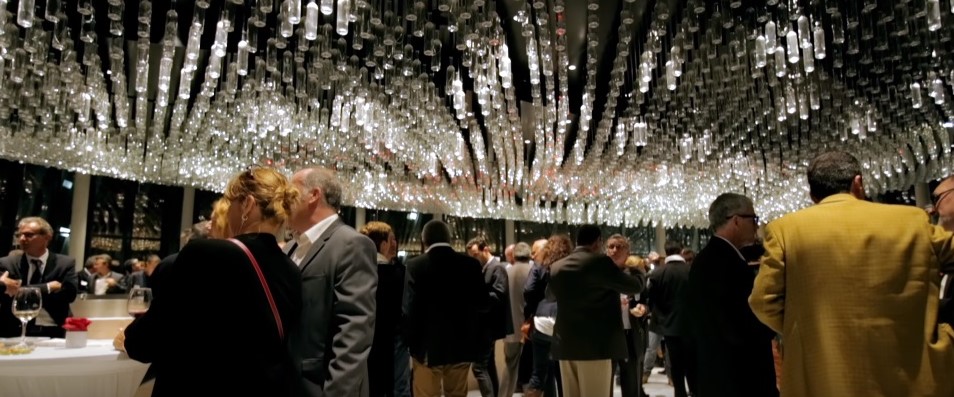
In this exceptional space, a monumental chandelier made of thousands of bottles and a 10-metre-long oak counter enhance the uniqueness of the location. Visitors round off their visit by tasting a wine of their choice from a regularly updated selection of twenty from across the world. Younger visitors can discover a grape juice specially chosen for them.
To ensure that a wide
range of global wines are available in the belvedere, La Cité du Vin has
established partnerships with interprofessional organisations in various wine
regions across the world.


RESTAURANT AREAS
Le 7 is the name of the
panoramic restaurant at La Cité du Vin. This constantly bustling space serves
sweet and savoury food from 10am to 11pm, and you can also stop for a glass of
wine, a coffee, or a glass of champagne, 7 days a week. You will be treated to
the most beautiful view of Bordeaux that any restaurant has to offer. Under the
direction of Bordeaux restaurant star Nicolas Lascombes, our chefs have
designed a generous menu offering regional, seasonal products, with global
influences. A perfect balance of Bordeaux savoirfaire and inspiration from
other civilisations of the world. Wine pairings are suggested for each dish.
Being a great wine-lover,
our head sommelier offers a selection of 500 wines from Bordeaux and beyond,
covering 50 countries. The list features the 25 great Bordeaux icons, as well
as a selection of 32 wines by the glass. Small producers have not been
forgotten, and the main idea is to provide pleasure and discovery to suit all
budgets. Sunday’s menu features seafood platters, with non-stop service until
4pm.


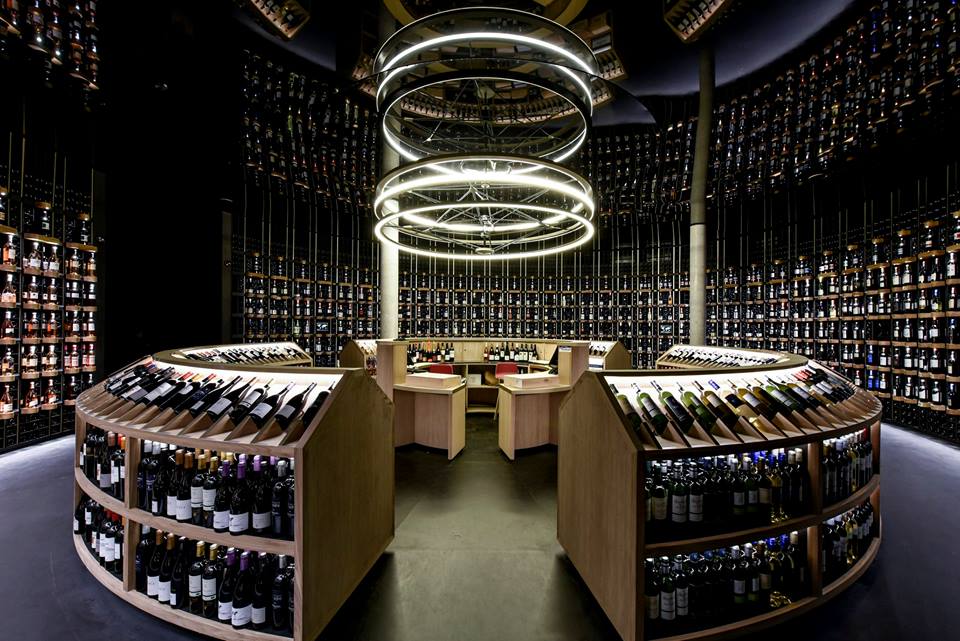
WINE CELLAR
This reference
cellar will offer more than 14,000 bottles of 800 wines, including 200 from
France and 600 from more than 80 countries across the world. This exceptional
range has been selected by Régis Deltil, a Bordeaux wine merchant, and his
tasting panel of key figures such as Andréas Larsson (World’s Best Sommelier
2007) and Michel Rolland.
BRASSERIE – WINE
BAR
Open for lunch and
dinner, the wine bar offers food accompa - nied by a selection of 40 bottles
from the cellar, by the bottle or the glass. This wine list changes to match
the La Cité du Vin cultural programme.
SNACK BAR
Open daily during the
day, the snack bar offers a variety of gourmet creations and global tapas to
eat in or take away. In - side or outside next to the Garonne, stop in for
breakfast, lunch or a snack break with a large range of homemade bread. Eight
wines will be available by the glass, with the list changing weekly.
Latitude20 is managed by
the Arom group run by Didier Oudin, in association with Régis Deltil and
Christian Messaris.
Latitude20 invites you to
travel and discover. The 20th parallel of latitude conjures up an image of New
World wines, ex - treme vineyards venturing between the 20th parallel north and
south. Wines from such places as Bali, India, Madagascar, Ethiopia, Brazil and
Tahiti will be available to discover in these restaurant areas and the
Latitude20 wine cellar. In addition to its clear wine reference, the number 20
also suggests the 2.0 nature of the space.


LA CITE DU VIN: WINE MUSEUM IN BORDEAUX DESIGN BY XTU ARCHITECTURE


CHATEAU CHEVAL BLANC

CHEVAL
BLANC
THE ORIGINES :
Although the exact
location of the first vines grown in Bordeaux is unknown, the vestiges of
luxurious villas – the ancestors of today's wine châteaux – have been found in
Saint-Emilion. One such villa belonged to Ausone (Ausonius in Latin),
poet-winemaker and Roman Consul in the 4th century AD. The expansion of the
Saint-Emilion vineyards continued through the centuries, especially during the
Middle Ages. The creation and development of the port of Libourne in the 12th
century, during the English occupation, led to thriving maritime trade that spread the reputation of Saint-Emilion
wines throughout Europe. They were already considered of superlative quality at
the time, with unusual ageing potential, and were often given as special gifts
to royalty and other important people. Poetically referred to as "the hill
with a thousand châteaux", Saint-Emilion has a colourful history. Skilled
and enthusiastic winegrowers have long contributed to its stellar reputation.
The
appellation surrounds the eponymous medieval town on a limestone plateau
situated east of Libourne, where the Isle and Dordogne rivers meet. Château
Cheval Blanc has an altogether unique terroir in Saint-Emilion. While most of
the appellation's other famous estates have limestone soil dating from the
Tertiary Period, Cheval Blanc's soil features alluvia from the Quaternary
Period deposited by the Isle. And like most of the prestigious estates in
Pomerol, Cheval Blanc's soil formation has a varied texture that does not
include limestone. However, Cheval Blanc is also different – and unique – in
that the proportion of gravel and clay is just about equal. This gift of nature
is essential in understanding the estate's history.
Archives
show that wines have been grown at Cheval Blanc at least as far back as the
15th century. Furthermore, a document dated 1546 shows that the owner at the
time leased the vineyard, and a contract from 1587 specified that the
sharecropper "will live there when the sun goes down to keep an eye on the
vines...". A century later, the "Au Cheval-Blanc" tenant farm
was sold to Bertrand de Gombaud for the sizeable sum of 1,400 francs. Two
winegrowers were living full-time at Cheval Blanc on the eve of the French
Revolution. This was very unusual at the time, and reflects how highly the
terroir was regarded.
A SUPERB REPUTATION:
The most prestigious part
of Cheval Blanc's history can be said to date from 1832, when Jean-Jacques
Ducasse, President of the Libourne Trade Tribunal, purchased the core of the
present-day estate. Over the next twenty years, the purchase of plots belonging
to Château Figeac led to the creation of the 39- hectare vineyard as we know it
today. The configuration has remained practically unchanged. The marriage of
Jean-Jacques' daughter, Henriette, with Jean Laussac-Fourcaud, a Libourne wine
merchant, opened a new chapter in the history of Cheval Blanc that would define
and consolidate the identity of this unique property.
After
Henriette inherited Cheval Blanc, her husband undertook a spectacular
renovation. He was among the first people to understand the importance of water
stress to produce the finest wines, and put in an efficient drainage system.
However, the greatest progress made by the new
owners was in the vineyard. Aware of Cheval Blanc's outstanding potential, and
helped by an extraordinary intuition, Jean Laussac-Fourcaud replanted part of
the estate in the 1860s with a totally atypical proportion of grape varieties:
half Merlot (the king of the Right Bank) and half Cabernet Franc. This
replanting was finished in 1871.
Formerly known as vin de Figeac, the wine was
first sold under the name Cheval Blanc in 1852. This was the beginning of a
prestigious career.
Jean
Laussac-Fourcaud focused on one goal for over thirty years: to make his wine
one of the very best in Saint-Emilion and to enhance its reputation. Cheval
Blanc obtained its first medal at the 1862 Universal Exhibition in London. In
fact, a representation of this bronze medal is found on the château's
present-day label. Cheval Blanc won their first gold medal at the 1878
Universal Exhibition in Paris, and this new distinction also appeared on the
label. In 1886, Cheval Blanc won a second gold medal at the Universal
Exhibition in Antwerp. Reflecting this series of successes and a wine well on
the way to achieving international recognition, a château was built on the
estate.
Cheval
Blanc was able to realise its greatest dream in the 1880s, when it began to be
considered on a par with the first growths of the Médoc – and one of the
most dependably fine wines in the world – by the wine trade and connoisseurs.
Thus, in the latter half of the 19th century, Cheval Blanc was in the same
price bracket as Margaux, Latour, Lafite, and Haut-Brion in Paris and London
auction houses. The wine's reputation earned it a place at prestigious meals,
major receptions, and state dinners.
APOTHEOSIS :
After Jean
Laussac-Fourcaud passed away in 1888, his widow inherited the estate. She, in
turn, left it to her son, Albert, who had reversed his hyphenated family name
by this time. Albert Fourcaud-Laussac perpetuated the work undertaken by his
father and installed twelve wooden vats that were used until 1966. Major
investments were made in the vineyard and selected old vines reproduced by mass
selection.
Albert's
two sons, Jacques and Joseph Fourcaud-Laussac, continued in their father's and
grandfather's footsteps. The same cellar master was in charge at Cheval Blanc
for 44 years – Gaston Vaissière poured his talent, energy, and enthusiasm into
making the most of a terroir he considered "magical"...
Cheval
Blanc obtained the highest possible distinction in the first classification of
Saint-Emilion wines in 1954: Premier Grand Cru Classé "A". This
exalted rank was confirmed in every following classification in each subsequent
decade. Cheval Blanc became a member of the exclusive "Club of 9"
comprising the first growths of Bordeaux.
A page was turned in
autumn of 1998 when Bernard Arnault and Baron Albert Frère, two old friends and
lovers of great wine, joined forces to became the owners of this fabled château
in Saint-Emilion. They injected a dynamic new spirit, while respecting the
château's history and existing facilities. They also placed their complete
trust in the winemaking team to continue their good work. The priority
today is the ultimate in quality, which calls for enormous attention to detail and
precision winemaking
Furthermore, Cheval Blanc
is resolutely turned towards the future. This is epitomised by the impressive
new cellar adjacent to the château. Designed by Christian de Portzamparc,
winner of the 1994 Pritzker Architecture Prize in 1994, this was completed in
June 2011. Reflecting the desire of Baron Albert Frère and Bernard Arnault,
this building is both futuristic and in keeping with the surrounding historic
vineyard landscape listed as a World Heritage Site by UNESCO.
Winegrowers have succeeded one another at Cheval Blanc for six centuries in the context of a "wine civilisation" some 2,000 years old. The wine from this estate is now a joy to men and women all over the world who are aware that a great growth such as Cheval Blanc is a treasure of voluptuousness and pleasure.


CHATEAU CHEVAL BLANC


BISTROT ! DE BAUDELAIRE À
PICASSO
( PAST EXHIBITION NEWS )
The exhibition Bistrot!
From Baudelaire to Picasso takes place from March 17th until 21st June 2017.
Containing around a hundred works, the aim of this exhibition is to highlight
the essential role played by cafés and bistrots, convivial spaces, in creation
and society from the 18th century until our days..
At times leaving France
behind for the rest of Europe and the USA, combining traditional media with photography
and cinema, it celebrates the living, fertile links between the world of the
arts and the world of the café.
Exploring the broad range
of situations created by cafés, from solitary drinker to pick-up scenes, from
melancholic withdrawal to identity affirmation, from male exclusivity to female
advocacy, the exhibition also examines what artists were trying to say about
themselves and their time. From section to section, the mobile geography of
these urban enclaves – open to all our dreams and all our encounters – leads
the visitors back to themselves.
ATMOSPHERE,
ATMOSPHERE
Both a space and a mood,
the café has challenged artists since the age of Louis XV, from Voltaire’s
Procope to the highly popular Ramponneau, to which Fichel’s large painting paid
yet another emphatic tribute at the Exhibition of 1877. How do you render the
interaction between light, bodies and glances which must enchant the eye of the
spectator? How do you capture the atmosphere and the flow of affects? The 18th
century, which saw a rise in the number of these places that were still
inchoate, gave birth to an iconography with enduring echoes. Present in the
works of the romantic writers and already a centrepiece of Daumier’s work, the
image of the café saw a renewal in the 1860s and 1870s. The temples of wine
symbolised the new sense of urban life and met the expectations of modernity
defined by Baudelaire. This wonderful observatory of contemporary morals
gave birth to the aesthetic of transience. Whether luxury establishment or "boozer"
worthy of Zola, each place possessed its own spirit which it imposed on the
artists. All the artistic leanings of the early 20th century, from
Fauvism to surrealism had to "drink from the source" and confront the
subject. More than any other social venue, cafés and bistros, dance halls and
cabarets, even café-concerts, form the heart of our modernity.
CHEAP THRILLS
In response to the bourgeois cafés of the Impressionists came the popularity of
the workingclass pub. Zola brought his custom and his naturalist art here. In
the wake of Daumier, Courbet and Bonvin, three close friends of Baudelaire, the
1880s and 1890s left a more plebeian mark on drinking taverns. However, all the
images of the worker are not from the same ilk. Just as the Third Republic
swung between liberalism and strict social regulation, the painters swayed
between glorification and condemnation of the effects of alcohol, of which the
café is the symbol, if not the hostage. Alongside these sinister
watering-holes, there is a positive iconography of wine : the people’s nectar,
invigorating nourishment in opposition to the idle classes’ champagne. This is
the kingdom of plonk ; the wine of the barriers or the countryside, cheaper
than in the city, the realm of the loose jacket and the cap. Léon Lhermitte
provided the archetype in his large painting at the Exhibition of 1885, one of
his masterpieces dear to Van Gogh. Wine and the people’s morale were reconciled
at the shrine of makeshift cafés. In their own style, Dunoyer de Segonzac, Gromaire,
Doisneau and Picasso in his "communist years" revived the worker’s
drink, the red wine of simple pleasures.


EDOUARD
VUILLARD
Café au Bois
de Boulogne, v. 1897-1898
Peinture à la
Colle Sur Papier
Besançon,
Musée des Beaux-Arts et d’Archéologie
© Photo:
Charles CHOPPET


HENRI DE
TOULOUSE LAUTREC (1864-1901)
The Chap
Book, 1895
Affiche Paris, Galerie Documents


MARK ROTHKO
Composition,
1929 - 1931
Huile Sur
Carton
Collections
of Kate Rothko Prizel and Christopher Rothko.
Artworks on
Canvas by Mark Rothko
©1998 by Kate Rothko Prizel and Christopher Rothko

YOU MAY LISTEN GAUTIER CAPUÇON


ATTRACTIONS
The promiscuity of the
sexes constituted one of the typical characteristics of the modern café, the
pernicious vices of which certain artists, such as Pissarro, decried by
ideology. The fruit of lucky magnetism, or mismatched, ephemeral or lasting,
for a fee or for free, the couple penetrated the artists’ work and gave rise to
all sorts of situations, from the most sensual to the most amusing. There were
still very few women in the cafés painted by Boilly in the 1810s and 1820s.
Manet, on the other hand, gave them his full attention. The incisive Forain
provided him with an excellent counterpoint. From the 1870s and 1880s on, the focus
often shifted to the solitary woman. This solitude, related or not to the theme
of reading and writing, was a self-assertion, even when the image was tinged
with melancholy. Foreign artists as much as French artists knew how to exalt
this typical feature of our society and the emancipation it permitted before
and especially after the First World War. Berlin in the 1920s, through Otto
Dix’s masterpiece, provides a more extreme ground for emancipation. Less openly
acerbic and in a style close to Hopper, the two paintings by Rothko and Guy
Pène du Bois yield to the charm of elegant young ladies, a little dreamy in
their cloche hats. Photography in the inter-war period was also besotted with
women in cafés, alone or in groups, the provocation of their number adding to
the audacity of their gesture.
BOHEMIAN DREAM
A refuge or a stepping stone, the café can be seen as a metaphor for the artist in conflict, a bohemian or a dandy, who rapidly identifies with these places where atypical individuals and cultures meet. Far from being a synonym of poverty or rejection, this temporary or fictional marginality sees itself as a keeper of the freedom to think, create and live. Like the heroes of the fairground world dear to Picasso, barflies become figures of the rebellious artist, with neither a place nor a definite role in society. A sort of paradoxical aristocracy... By closing up on the café as a sanctum and an allegory of the condition of the modern artist, the exhibition invites the public to question the reasons for this mythology, substituted today by the figure of the artist celebrated by the media and the market. Why, since the 1970s, do artists and writers not feel the same need to gather "at the café" and capture its image? In 1976, Renato Guttuso announced the decline, but not the end of these "secular pentecosts"! Moreover, certain artists continue to make the café one of the emblematic places of their creation, a place that is both open and closed, where the culture of pleasure and debate is elaborated. Eternal youth of cafés and wine bars!
https://www.laciteduvin.com/en/experience-la-cite-du-vin/temporary-exhibitions/bistro-baudelaire-picasso


CHARLES
CAMOIN
La petite
Lina, 1907
Huile Sur
Toile,
Marseille,
Musée Cantini
©Photo Claude Almodovar et Michel Vialle © ADAGP, Paris 2017


ARLES CAMOINDANIEL HUMAIR 2014 JAZZ A VIENNE


LA CITE DU VIN: WINE MUSEUM IN BORDEAUX DESIGN BY XTU ARCHITECTURE

A CONTROLLED
ENVIRONMENTAL IMPACT
The Bassins à Flot site
is one of the symbols of development in Bordeaux. Located between Chartrons and
Bacalan, this former manufacturing hub is in a state of radical transformation:
a huge 160-hectare construction site (including 22 hectares of water bodies,
the eponymous basins) home to flourishing major projects and buildings. This will
ultimately cover 700,000 m² with a mixture of housing, economic activity and
public facilities springing up, just six tram stops from Place des Quinconces.
La Cité du Vin is in
perfect keeping with the district’s ecological philosophy: every effort has
been made to minimise the project’s environmental impact. 70% of La Cité du
Vin’s energy needs are therefore covered by local and green energy sources. In
addition, the architects have devoted considerable attention to optimising the
building’s bio-climatic performance. Air inlets low down on the structure allow
breezes to enter and create a current which ultimately pushes hot air out via
the upper courtyard areas and outlets, thus optimising ventilation and reducing
the need for air conditioning. Respectful of the environment and the ecosystem
of the banks of the Garonne (a listed Natura 2000 Zone), the landscaped areas
around the building will mimic the riverbanks to provide a touch of natural
freshness and maintain a sense of continuity.
The building fits
perfectly into the dynamics of the Bassins à Flot eco-district, and was
designed to have a controlled environmental impact (in line with the High
Quality Environmental standard). Here are a few examples:
70% of La Cité du Vin’s
energy needs are covered by local and green energy sources • The building’s
compact shape enables natural ventilation in summer (gain of 5 degrees, reduced
air conditioning use) and limits heat loss in winter • The site can be reached
via less CO2- heavy methods of transport such as tram, bicycle and on foot •
The interior materials have an A+ rating to guarantee good air quality • The
wood used comes from sustainably managed forests • The rainwater recovery tank
is used to water and clean the area around the building • The composting area
is used to treat waste from catering areas and organic waste
ENERGIE DES BASSINS
In the fight
against climate change, France has two priorities: energy saving and renewable
energy.
With its plan for 5,500
housing units, the Bassins à Flot area will welcome more than 10,000 new
inhabitants when completed, and feature flagship projects such as La Cité du
Vin. In order to establish this area as an exemplary model in terms of energy,
a heating network is the solution of choice.
Mixener and EDF Optimal
Solutions have come together to design and install a heating network for this
sustainable district. The network operator is Idex.
Across the territory, the
heating network uses local resources: biomass, geothermics, energy recovery
units and methanisation.
These local and clean solutions will save 8,000 tonnes of CO2 from being
rejected into the atmosphere. Energie Des Bassins is owned by Régal-Bordeaux,
via its Mixener subsidiary specialised in innovative heating networks, and by
EDF Optimal Solutions, specialising in ecologically efficient energy solutions.


LA CITE DU VIN: WINE MUSEUM IN BORDEAUX DESIGN BY XTU ARCHITECTURE


XTU ARCHITECTS
The Parisian agency XTU
Architects was created by Anouk Legendre and Nicolas Desmazières. Anouk
Legendre trained at the Bordeaux School of Architecture. An encounter during a
study trip and a personal bond formed soon grew into a professional partnership.
Following experiences in Iceland, they began to develop a vision of a world
‘composed entirely of movement, of shifting forms’, where in some contexts ‘the
curve has come to replace the line’. The bold lines and angles which had
dominated previous high-profile creations such as the new Chemistry Department
at Paris VII University (completed in 2008) now gave way to rounded forms
inspired by the curves of the earth. The best examples are the Jeongok
Prehistory Museum north of Seoul in South Korea (completed in 2011), the French
Pavilion for the 2015 Universal Exposition in Milan, and La Cité du Vin in
Bordeaux. Addressing each project’s intrinsic challenges, XTU’s buildings
sometimes evoke a level of futurism. Constantly striving to plan ahead, the
agency has its very own research and exploration department where intersection
of knowledge sits at the forefront. This has for example led to the development
of cutting-edge technology for photosynthetic facades which can grow
microalgae, called ‘biofacades’, for which they hold numerous patents. These
projects have been presented at numerous exhibitions and in various
publications both in France and abroad.


