January 22, 2013

GINZAN ONSEN FUJIYA HOTEL DESIGN BY KENGO KUMA


GINZAN ONSEN FUJIYA HOTEL DESIGN BY KENGO KUMA


GINZAN ONSEN FUJIYA HOTEL DESIGN BY KENGO KUMA
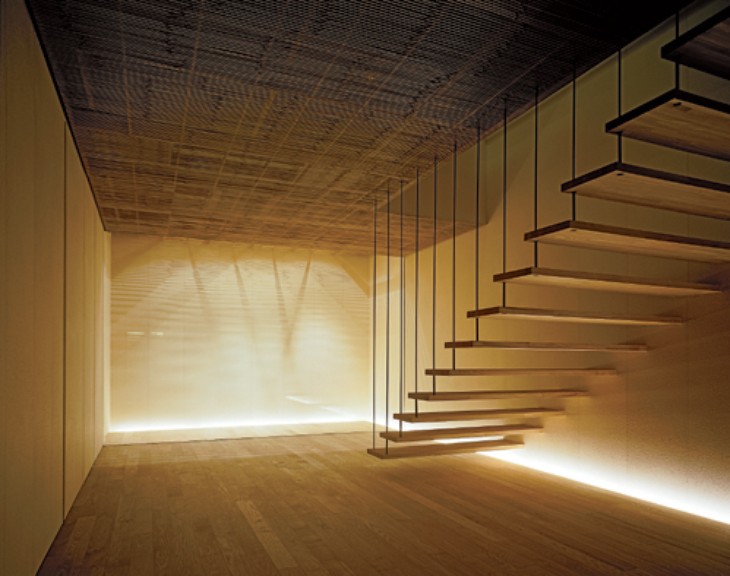
A wooden 4 story Onsen ( Hot spring ) Hotel stands at the bottom of a valley in a region of snow. The existing facade was renovated utilizing wood from the orjinal 100 years old hotel while the interior space was reorganized by a delicate screen made from 4 mm wide slits of bamboo ( Sumushiko ) . An almost transparent stained glass called Dalle de Verre first used in the middle ages is fit into the opening which faces the extorior space. These bamboo screens, neither transparent nor opaque, provide a soft light and shade the interior creating a space to heal and relax, complementing to effects of bathing in an Onsen. 
All the information and some pictures had taken from Kengo Kuma' s web page. Others had taken from Fujiya Hotel own page, Uniqhotels' s web page and photographer Jimmy Cohrssen' s web page.
What makes this hotel so special is your host’s meticulous adherence to Japanese inn-keeping traditions; the aim of which is to anticipate and meet your needs before you are even aware of them yourself. Your hostess, Jeanie Fuji, is arguably the world’s best practitioner of the traditional Japanese art of hospitality. It has even gained her celebrity status in Japan which she accepts with demure modesty. The hotel is over 350 years old and has recently been updated to accommodate the needs of the international traveler without scrimping on traditional Japanese aesthetics. Layered bamboo screens majestically order the interior space while the light shines through many stained glass windows. Textured paper screens imbibe the areas with a sense of calm which you can enjoy before taking a dip in one of 5 natural spa pools fed by the areas famous, Ginzan Onsen (hot springs). There is even one on the roof offering you views of unprecedented beauty while you soak in the revitalizing waters. The philosophy of Fujiya Ginzan is to assist you in resting and restoring your holistic self. Prepare to leave with new levels of well being emanating through your body and mind.


B


B


KENGO KUMA
BIOGRAPHY
2008   Established Kuma & Associates Europe ( Paris, France)
1990   Established Kengo Kuma & Associates
1987   Established Spatial Design Studio
1979   Completed the Master Course, Department of Architecture, Graduate School of Engineering, The University of Tokyo
1954   Born in Yokohama, Kanagawa Prefecture, Japan
TEACHING & PROFESSORSHIPS
2009 - Present - Professor at the Graduate School of Architecture, The University of Tokyo
2007 – 2008 - Visiting Professor at the School of Architecture, University of Illinois at Urbana - Champaign ( Chicago, USA )
2001 – 2009 - Proffessor at the Faculty of Science and Technology, Keio University
1998 – 1999 - Proffessor at the Faculty of Environmental Information, Keio University
1994 -  Lecturer at the Graduate School of Architecture, Planning and Preservation, Columbia University ( New York – USA )
1985 - 1986 - Visiting Scholar Graduate School, Columbia University and Asian Cultural Council ( USA )
PROFESSIONAL AFFILIATION
First class Architect in Japan
Architecte DESA ( Diplome de l’ Ecole Speciale d’ Architecture
Architecte Inscrit au Tableau de l’ Ordre des Architectes
International Fellow for Royal Instıtute of British Architectes ( RIBA )
Honorary Fellow fort he American Institude of Architects ( AIA )
Received a Ph D from Keio University
AWARDS ( For Kengo Kuma )
2012   The 6th ASIAGRAPH Award
           Japan Information – Cultuology Society Award
2011   The Minister of Education, Culture, Sports, Science and Technology’ s Art       Encouragement Prize for ‘’ Yusuhara Wooden Bridge Museum ‘’
2010   Mainichi Art Award for ‘’ Nezu Museum ‘’
2009   Decoration Officier de L ‘ Ordre des Arts et des Lettres ( France )
2008   Energy Performance + Architecture Award ( France )
           Bois Magazine International Wood Architecture Award ( France )
2002   Spirit of Nature Wood  Architecture Award ( Finland )
2001   Togo Murano Award for ‘’ Nakagawa – machi Bato Hiroshige Museum ‘’
1997   Architectural Institute of Japan Award for  ‘’ Noh Stage in the Forest ‘’
           First Place , AIA Dupont Benedictus award for  ‘’ Water Glass ‘’ ( USA )


January 20, 2013

REACH RUIN EXHIBITION / DANIEL ARSHAM


A
DANIEL ARSHAM
Reach Ruin Exhibition / December 14 - Mid. March 2013
Fabric & Workshop and Museum / Philadelphia - USA
A
A
DANIEL ARSHAM
Reach Ruin Exhibition / December 14 - Mid. March 2013
Fabric & Workshop and Museum / Philadelphia - USA
Sola Agustsson
Daniel Arsham toys with our conception of space and time. His exhibitions are full of melting walls, pixelated clouds and disorienting sculptures. His objects and installations, like storms, are never static, transforming our notions of temporal stability. The mind-bending showReach Ruin covers three floors, connecting architecture, sculpture, and live dance performances.
The initial inspiration for Reach Ruin was 1992’s Hurricane Andrew and the destructive power of nature. How do you express that kind of natural power through sculpture?
There are a number of works in this show that imagine the destructive power of nature in a way that is constructive. Some pieces use shattered glass and re-form it back into objects. So there’s this idea of a useless, ruined material, like broken glass, transformed back into something that has intention and purpose.
A
A

How affected were you by the 1992 hurricane?
It was a very pivotal experience in my childhood. I had never directly referred to it in my work until recently. This year was the 20th anniversary of the storm, so I found it pertinent to go back and explore this idea of witnessing the house I grew up in, the space I knew, being totally dismembered.When my family emerged from storm the house was basically not there. There were these giant holes in the roof, the windows were blown out, and there was two feet of water throughout the entire house. Ironically when I started doing these works, New York had not experienced a storm like that, but this topic has become much more relevant in the wake of Hurricane Sandy.
I also sense a manipulation of time, in addition to the changing forms.

The notion of time is different in natural disasters. Storms have an impact on the physical world in this very rapid way—a storm could last, say, twelve or twenty-four hours. The works in this exhibition imply a slow, geological time frame. There are these very large columns in the exhibition that are eroded and look like some sort of cavern.
B
B
B
How does Jonah Bokaer’s choreography in Study for Occupant add to this? What was your intention in combining these forms?
In this exhibition, one floor is reserved for a collaborative performance with choreographer Jonah Bokaer. We have collaborated on performances and exhibitions in the past, and in this instance, he related the choreography directly to the sculptures. I had cast twenty different cameras in plaster, and during the routine the dancers actually pick up these plaster cameras and draw with them on the floor. They inscribe circles and line patterns on the ground, almost like you would on a chalkboard. So the cameras are disintegrating over the floor during the performance. We also block out all the lighting and use a blue gel. It makes the space reminiscent of a twilight after a storm, a kind of ethereal quality.
You also have a show in Paris entitled Storm which will be at the FWM as well. Was this also inspired by the 1992 hurricane?
Both of these exhibitions Reach Ruin and Storm relate back to my experience with the hurricane. In some ways they are sister shows. They don’t share the same exact works, but there are overlaps. In Paris, the exhibition has a number of pieces that manipulate the surface of architecture.
There’s a piece, Moving Clock, which is a clock that pushes itself along the wall. I spoke before about this notion of time in contrast to the silence and quickness of a storm. The gesture is quiet and nonviolent. It looks like the wall is made out of fabric and the wall is being manipulated. Architecture can perform in unexpected ways and do things it’s not supposed to be doing, if it’s in a state of movement, melting, or transition. Architecture as we perceive it is not supposed to move. And if if it does, something’s wrong.
A
A
You founded Snarkitecture in 2008 with Alex Mustonen. Can you tell me about that?
Much of my work has been about the manipulation of architecture. Oftentimes I run up against problems with building codes and trying to make things permanent in non-gallery spaces. I began to work with Alex Mustonen, who is now my colleague at Snarkitecture. The name “Snarkitecture” comes from a Lewis Carroll poem “The Hunting of the Snark,” in which a group of misfit idiots search for this thing called a “snark,” but they don’t know what it is or where it is or what it looks like, and they use these white masks to find it. So this search for a formless entity partially informs our practice. We function somewhere between the discipline of art and the discipline of architecture. But in many ways we’re neither.
Reach Ruin is at the Fabric Workshop & Museum in Philadelphia from December 14 through March 31.
Interview and some picture had taken from Artlog' s web page. If you would like to read Daniel Arsham's  biography and exhibition information please click Fabric & Workshop Museum' s web page. You may visit to see his others work and more information to click his own web page. Some pictures taken from his web page to give general information.
A
A
A
A
A
A
B
A
A
A
A
A
A


B
DANIEL ARSHAM


January 19, 2013

FOSCARINI TROAG LIGHT DESIGN BY LUCA NICHETTO


FOSCARINI TROAG LIGHT DESIGN BY LUCA NICHETTO


FOSCARINI TROAG LIGHT DESIGN BY LUCA NICHETTO
Tröag is the Swedish word for a canoe-shaped wooden bowl used for crushing fruit or for letting bread rise. During a trip to Lapland, Luca Nichetto was introduced to this object, which is passed on from generation to generation and it has provided the source of inspiration for a longitudinal suspension lamp designed to illuminate work areas like long tables or large open spaces. Troag is composed of a single piece of curved wood rather than a traditional lampshade. Intense yet not blinding, the uniformly diffused light the lamp produces is directed both downwards and upwards thanks to slits running along the top of the wooden shade. Troag is available in three different versions of varying lengths.
All photographs had taken by © Massimo Gardone.

http://nichettostudio.com/projects/troag/


A


NICHETTO STUDIO
In 2006 Luca Nichetto founded a multidisciplinary design studio in Venice, Italy, which specialised in industrial design, product design and design consultancy. From the very beginning, this studio collaborated with a number of different brands and organisations, quickly expanding its influence far beyond Venice and Italy’s borders. Five years later, in 2011, Nichetto opened a second studio in Stockholm, Sweden. This practice was founded in response to an ever growing number of requests for collaboration from international companies, with the studio’s work also broadening out from its initial focus on designed objects. Nichetto Studio has since expanded into areas such as interior design and architecture.
Today, Nichetto Studio works with a variety of brands and clients from all around the world, and its expertise is sought out across all design disciplines. A deep passion for, and knowledge of, industrial and craft manufacturing processes runs through every aspect of the studio’s work. Nichetto Studio’s projects abound in carefully selected cultural references and a keen attention to detail. The practice’s unique position within both Scandinavian and Italian design culture has given Nichetto Studio worldwide recognition. Appreciation of its work extends far beyond the confines of the design industry.
http://nichettostudio.com/about/


‘’ We start our projects from an instinctive and imaginative place that we subsequently develop through rigorous research and processes to generate unique and innovative ideas. ‘’
Luca Nichetto


‘’ We believe that different objects can work well together for optimal use, and function independently. ‘’
Luca Nichetto


A
LUCA NICHETTO' S VIDEO


LUCA NICHETTO
Luca Nichetto was born in 1976 in Venice. He studied at the city’s Istituto statale d’arte, before undertaking a degree in industrial design at the Università Iuav di Venezia, from which he graduated in 1998. In 1999, Nichetto began his professional career with Murano-based glass maker Salviati, later becoming a product designer and consultant for lighting company Foscarini. In 2006, he founded his eponymous practice in Venice. In 2011 he moved to Stockholm, Sweden, to open a second studio and he continues to live in and work from this city. Over the course of his career, Nichetto has served as art director for many international design brands and he has developed an in-depth knowledge of the design industry.
He has lectured and led workshops at various universities, including serving as a professor of design at the Università Iuav di Venezia, as well as sitting on juries for assorted international design competitions. Nichetto’s work has been exhibited worldwide and has been the subject of retrospectives in cities such as Venice, London, Paris and Stockholm. He has been awarded numerous international design awards for his highly researched, innovative design projects, which range across products, furniture and accessories, as well as incorporating architecture and exhibition design.
http://nichettostudio.com/about/