


JOAN MIRÓ
1. LIFE & WORK
(I) CHILDHOOD AND WORK, TO 1919
Miró came from a family of craftsmen.
His father Miquel, the son of a blacksmith, was a goldsmith from the vicinity
of Tarragona in southern Catalonia; his mother, Dolors Ferrà, was the daughter
of a carpenter from Mallorca. He initially obeyed his family’s wishes that he
follow a business career by studying at the Escuela de Comercio in Barcelona
from 1907 to 1910, but in 1911 an attack of typhus, coupled with nervous
depression, enabled him to abandon the course. He recuperated in his parents’
country house at Montroig, south of Tarragona, a peaceful place to which he
often returned in later life and in which his artistic vocation and devotion to
nature were confirmed. Plants, insects, simple forms of life; the stars, sun,
moon and sea, especially the Mediterranean; the cultivated countryside itself,
together with elements of rural existence, all later found their way into his
work.
In 1907 Miró began his artistic
training in Barcelona at the Escuela de Artes y Oficios de la Lonja, where
Picasso had studied 12 years earlier; his teachers were Modest Urgell
(1839–1919) and Josep Pascó (1855–1910). In 1912 he entered the escuela de arte
run by the great teacher Francesc Galí (1880–1965), and there met the potter
Josep Llorens Artigas, with whom he formed a lifelong friendship. Galí noticed
that Miró had an aptitude for colour but difficulty in delineating shapes, and
therefore blindfolded him so that he would acquaint himself with the forms by
touching them before drawing them or modelling them in clay. Miró’s first
paintings date from this period, for example The Peasant (1914;
Paris, Gal. Maeght, see 1981 exh. cat., p. 49). In 1915 Miró left the Escuela
Galí and began attending drawing classes at the Círculo Artístico de Sant Lluc,
where Artigas was again a fellow student and where he met Joan Prats
(1891–1970), who became another great friend. In 1918 Miró became one of the
first members of the Grupo Courbet, an association of artists founded by
Artigas with other students from Sant Lluc.
Between 1915 and 1918 Miró briefly
painted in a manner that he himself described as Fauve, using strong, bright
colours. His tendencies, however, to geometry, broad brushwork and a clarity of
construction distanced his work from the earlier movement. During this period
he painted figures, as in his portrait of V. Nubiela (1917;
Essen, Mus. Flkwang), as well as landscapes and views of villages in the
province of Tarragona, for example The Road from En Güell (1917; New
York, MOMA). 1918 was a decisive year: Miró held his first one-man show in the
Barcelona gallery run by Lluís Dalmau, a key figure in the Catalan avant-garde,
who in 1912 had dared to exhibit the Paris Cubist painters. It was vital to
Miró’s development that Barcelona was then a very lively cultural centre that
attracted foreign artists seeking refuge from World War I.
Miró remained faithful to the
brilliance of colour of his early work, but under the influence of Paul Cézanne
and Cubism he
continued to emphasize the underlying construction of his pictures. In his
works of 1918 to 1922 he introduced a meticulousness and precision of drawing,
not out of an interest in illusionism or
in a slavish adherence to perceived reality but as a means of concentrating
attention on particular details. This new tendency is especially evident in
paintings such as Vegetable Garden with Donkey (1918; Stockholm, Mod.
Mus.) and Montroig, the Church and the
Village (1919; Spain, priv. col., see 1986 exh. cat. by R. S. Lubar and
others, no. 16). The self-portrait sometimes known as Young Man in Red
Shirt (1919; Paris, Mus. Picasso) and subsequent works, such
as Standing Nude (1921; Chicago, IL, Alsdorf Found.), display
a stylization and flatness, which can perhaps be traced to the Romanesque
paintings that had greatly impressed him in the Museu d’Art de Catalunya in
Barcelona. The general sense is of containment, as opposed to the almost
uncontrolled colour and violence of the previous period.

(II) PARIS 1920 - 1939
The failure of Miró’s exhibition of
1918 caused him to reconsider his methods, particularly after his move to Paris
in 1920 after a trial visit there in 1919. He worked initially in Pablo
Gargallo’s workshop at 45 Rue Blomet. In 1921, thanks to Lluís Dalmau, he held
his first exhibition in Paris at the Galerie La Licorne but failed to make any
sales. Following the exhibition and in many succeeding summers, he returned to
his refuge in Montroig. There, after a period of reflection, he began work
on The Farm (1921–2; Washington, DC, N.G.A.), his best-known painting
of the period, with which he seemed to return to the simple things that he
found around him in the Tarragona countryside. The apparent ingenuousness of
detail and innocence exuded by objects and organic forms alike masks only
partly the growing sophistication of Miró’s conscious and carefully elaborated
visual language. None of the dealers to whom he showed the painting was
interested in buying it, but he later sold it to Ernest Hemingway, with whom he
had struck up a friendship at a gymnasium where they both boxed.
In 1923 there were signs of another
change. The Tilled Field is representative of this period, which
follows on from The Farm in its mixture of recognizable natural forms
with more or less invented shapes; colour is now treated with less restraint,
freed from the demands of realism. The stylized realism of his previous
portraits is still in evidence in the treatment of the woman and cat in
the Farmer’s Wife (1922–3; priv. col., see 1986 exh. cat. by R. S.
Lubar and others, no. 22), but the main direction of his work, already evident
in Vegetable Garden with Donkey, was towards an explosion of form verging
on abstraction.
This development culminated in Harlequin’s Carnival (1924–5; Buffalo,
NY, Albright–Knox A.G.), which can be regarded as Miró’s first characteristic
image, in which the space is populated by fantastic shapes suggestive of living
organisms, no matter how tenuously figurative they at first appear. Miró here
established the limits of abstraction, to which he would remain faithful
until c. 1960, characterized by an urge to retain at least vestigial
references to perceived reality.
However resistant Miró felt to being
part of wider artistic movements, he was influenced during the 1920s by the
spirit of both Dada rebellion
and Surrealism.
André Breton himself remarked that ‘Miró is the most surrealist of us all’, in
spite of the fact that Miró never officially joined the group. In Paris in 1925
Jacques Viot’s Galerie Pierre held not only a one-man show of Miró’s work but
also an exhibition of Surrealist painting, which included Miró along with Picasso
and Paul Klee.
Miró’s most abstract early paintings
were virtually monochromatic canvases produced between 1925 and 1927, often
dominated by a blue background, as in Painting (1925; New York,
Guggenheim). These were to prove a powerful influence on the later development
of abstract art, particularly in the USA, where the succeeding generations
associated with Abstract
Expressionism and colour field painting both owed much to his
example. In works such as This Is the Colour of My Dreams (1925;
priv. col., see 1986 exh. cat. by R. S. Lubar and others, no. 42), in which the
title is inscribed next to a pool of blue paint, he used writing to change the
significance of apparently abstract shapes, creating a kind of concrete poetry
that recalled similar methods used in the previous decade by Guillaume
Apollinaire and by Dadaists such as Francis Picabia.
Head of a Smoker (1925; Chicago,
IL, Mr & Mrs M. G. Neumann priv. col., see 1986 exh. cat. by R. S. Lubar
and others, no. 41) features the undulating biomorphic shapes that Miró was to
favour in his subsequent work. In 1928, after a trip to the Netherlands, he
produced a series of Dutch Interiors such as Dutch Interior
I (1928; New York, MOMA), based on postcard reproductions of Old Master
paintings. In these a greater curvilinear freedom was introduced to the sharp
definition of shapes that had characterized earlier works such as The
Farm. He reinterpreted other works by earlier artists in a series
of Imaginary Portraits such as Portrait of Mrs Mills in 1750 (after
Constable) (1929; New York, MOMA). During this period he also
incorporated collage elements
into paintings such as Spanish Dancer (1928; New York, Acquavella
Gals, see 1986 exh. cat. by R. S. Lubar and others, no. 59) as a means of
enriching the surface; a group of these was exhibited in 1928 at the Galerie
Georges Bernheim, Paris.
Miró’s marriage in Palma de Mallorca on
12 October 1929 to Pilar Juncosa, a cousin on his mother’s side, followed by
their move to Paris, provided him with the stability and concentration that he
always needed for his work. Paradoxically this domestic tranquillity initiated
a period of extreme rebelliousness in his art. Between 1929 and 1931 he sought
to break all conventions including, on occasion, the very notion of painting
itself; he even spoke of ‘the murder of painting’. He began to produce reliefs
such as the wood and metal Construction (1930; New York, MOMA) and
sculptural assemblages such
as Sculpture-object (1931; Amsterdam, Stedel. Mus.), and he
intensified his use of collage by
incorporating unusual materials. His spirit of experimentation was especially
evident in Drawing-collage (1933; New York, MOMA) and other similarly
titled works made at Montroig in summer 1933, in which he combined humour with
compositional freedom, and a series of collage paintings initiated in 1933,
such as Painting-collage (1934; Philadelphia, PA, Mus. A.), in which
he relied both on intuition and on a meticulous and rational examination of
form.
From 1934 to 1936 Miró produced a series of Wild Paintings, such as Rope and People I (1935; New York, MOMA), which manifested a violence that had heretofore generally been kept under control. Aggression, sexuality and drama here took a deformed and grotesque human form which was emphasized by strange and unexpected materials and surfaces; in some cases paint was mixed with sand and applied to cardboard, while in others he scrawled graffiti on masonite or over paper prepared with tar.
A particularly important painting from
this period, marked by a shocking conjunction of intense imagery and shrill
colour, is Still-life with an Old Shoe (24 Jan–29 May 1937; New York,
MOMA), painted at the beginning of the Spanish Civil War. The political
tensions of the period are likewise reflected in The Reaper, also known
as Catalan Peasant in Revolt (1937; lost, see Dupin, 1962, p. 329),
which he painted for the Spanish pavilion of the Exposition Internationale des
Arts et Techniques dans la Vie Moderne in Paris in 1937 but which disappeared
when the pavilion was dismantled. The rage against injustice that it embodied
was categorically expressed also in the poster that he designed for the
Republican cause, Help Spain in which the slogan ‘Aidez l’Espagne’
was emblazoned over the image of a figure with outstretched arm and clenched
fist.

(III) PAINTINGS 1939 – C. 1950
In 1939 Miró settled in Varengeville, a
small village in Normandy, where he sought refuge from the conflict in Spain
and in Europe at large. There he produced a series of pictures named after the
town, for example A Drop of Dew Falling from the Wing of a Bird Awakening
Rosalie Asleep in the Shadow of a Cobweb (Dec 1939; Iowa City, U. IA Mus. A.),
in which he made recourse to memories of his childhood and of the countryside
of Montroig. In such works he expressed a poetic wonder at the universe in a
solitary communion with objects and living things, by means of imagery of
almost childlike innocence: skies filled with stars, birds and schematic female
figures all engaged in a sacred dance. These are among the high points of
Miró’s art and of his vision of the world.
On his return to Spain, Miró spent some
years in quiet retirement because of his opposition to the Franco regime.
Nevertheless his art continued to evolve. During 1940–41, in Palma de Mallorca
and in Montroig, he painted a series entitled Constellations. These
pictures, such as the Beautiful Bird Revealing the Unknown to a Pair of
Lovers (1941; New York, MOMA), represent the culmination of the abstract
tendencies of his early work. The first major retrospective exhibition of his
work, held in 1941 at the Museum of Modern Art, New York, was of great
importance in gaining him wider international recognition; the exhibition
catalogue was the first major study of his work.
During 1942 and 1943 Miró developed
elements from the Constellations in an intense burst of experimental
activity. He worked almost exclusively on paper in a variety of media including
oil, gouache,
watercolour, pastel, coloured pencils, Indian ink, and pencil. Works from this
period, such as the watercolour Woman, Bird, Star (1942; Lucerne, Gal.
Rosengart, see 1986 exh. cat. by R. S. Lubar and others, no. 125), are marked
by great spontaneity and elegance.
The success of Miró’s New York
retrospective and of his 1945 exhibition at the Pierre Matisse Gallery, also in
New York, led to a commission for a mural measuring 3×10 m for the Gourmet
Restaurant, Terrace Hilton Hotel, Cincinnati (1947; Cincinnati, OH, Thomas
Emery’s Sons, see Dupin, 1962, p. 404). In 1946 he exhibited for the first time
in the Galerie Maeght in Paris, with which he thereafter maintained a close
relationship.
The fullness of Miró’s art emerged in the 1940s. Bullfight (1945; Paris, Pompidou) is typical of this period in its graphic style and rounded forms, by which colour masses are contrasted with line drawing. Women at Sunrise (17 June 1946; Kansas City, MO, Nelson–Atkins Mus. A.) relies on a similar combination of drawing and coloured shapes on a neutrally coloured background. One of the major works of this period is The Red Sun Gnaws at the Spider (2 April 1948; New York, Stephen Hahn, see 1986 exh. cat. by R. S. Lubar and others, no. 135), in which the characters are almost completely abstract, and two of the shapes appear surrounded by a halo, the whole set against a uniform green background.
In general Miró established a dialogue
between two or more figures. Occasionally he linked the separate elements with
a line, as he had done in the Constellations, for example in Dragonfly
with Red Pinions in Pursuit of a Snake Gliding in a Spiral towards a
Comet-star (1951; Barcelona, Fund. Miró), although the festive atmosphere
of the earlier series is now less in evidence. In other works such as The
Little Blonde in the Amusement Park (1950; Berlin, Neue N.G.), colour is
the decisive factor in defining the principal shapes. It could be said that a
certain coarseness creeps into the joy and gaiety of the early 1940s, although
one can still enjoy the play of pure colour in such witty works as Mural
Painting for Joaquím Gomis (oil on fibro-cement, 1948; Barcelona, J. Gomis
priv. col., see Dupin, 1962, p. 555).

(IV) EXPERIMENTS WITH
PRINTMAKING, CEREMICS, SCULPTURE AND PAINTING IN THE 1940’s AND 1950’s
Having thus completed the elements of
his artistic vocabulary and self-contained world of imagery, Miró nevertheless
sought new challenges by introducing further techniques in a continued defiance
of accepted conventions. He returned to printmaking and in 1944 completed a
series of 50 black-and-white lithographs entitled Barcelona , which
he had begun in 1939: aggressive images full of monstrous, threatening
characters, a private denunciation of war.
Miró also began at this time to work
with ceramics in collaboration with his friend Josep Llorens Artigas. Having
produced his first vase in 1941 (Paris, Pompidou), from 1944 to 1946 he
decorated irregularly shaped fragments of pots, which had been broken during
the firing process. Typical of these were the Plaques completed
in 1945–6 (see Corredor-Matheos and Pierre, 1974, nos 13–45). Miró again worked
with Artigas from 1953 to 1956, this time on a series collectively known
as Lands of Great Fire: cups, plates and extremely varied shapes, in which
Miró, with Artigas’s technical assistance, explored the sculptural
possibilities of clay. The French title, Terres de grand feu, made punning
reference not only to the firing process and to the medium (terre cuite, Fr.:
terra cotta) but also to the prevalence of natural shapes in works such
as Monument (1956; Hamburg, Mus. Kst Gew.). Architectural forms also
feature in large-scale works such as Portico (h. 3.6 m, 1956; New York,
Guggenheim).
Prior to 1950 Miró had exhibited a series of sculpture-objects in Paris, but it was only after his involvement with ceramics that he began to produce sculptures on a larger scale. In 1954 he carried out a series of seven Projects for a Monument (Barcelona, Fund. Miró), in which he combined bronze, stone, wood and cement with more unusual materials such as porcelain, leather and even a telephone bell.
Between 1949 and 1950 in Barcelona,
Miró produced 55 paintings and approximately 150 drawings, sculptures, objects
and prints reflecting two distinct and contrasting approaches: on the one hand
carefully wrought and reflective, on the other extremely spontaneous. He
continued in the 1950s to develop the methods he had used in the previous
decade, but in works such as Personage on Cloudy Background (1953;
Paris, Gal. Maeght) he began to favour a less precise line, as if to dissociate
the figures from the more abstract signs that came progressively to dominate
his painting. His activities as a printmaker, which had heretofore been limited
to etchings and lithographs printed in black, from 1948 included a wider range
of media such as colour lithographs, colour etchings, drypoints, woodcuts and
later carborundum prints; on occasion he added hand-coloured elements, as in
the Parchment series (1953), in which he superimposed bold designs in
bright watercolour on to etchings printed in black on irregularly shaped sheets.

(V) AFTER 1960
Miró’s work underwent a profound change
in 1960, when he began to use black both to outline shapes and to fill them in.
His later work is dramatic, even tragic, with colour often suppressed or
counteracted by the weight accorded to black, as in Woman and
Bird (1964; Saint-Paul-de-Vence, Fond. Maeght). His faith inabstraction was
expressed during this period with particular eloquence in large canvases such
as Blue II (1961; Paris, Pompidou), in which broad strokes of colour
are set against sensuously painted backgrounds, as in his paintings of the
mid-1920s; the simplicity of gesture and boldness of scale and handling make
these among his most impressive and influential later works.
In his last years, before old age began
to limit his apparently irrepressible vitality, Miró continued to experiment
with different techniques. He collaborated with Joan Gardy Artigas
(b 1938) on ceramics, with Josep Royo (b 1945) on tapestries and with
the Barcelona theatre group Claca on the presentation of a play, Mori el
Merma, inspired by Alfred Jarry’s Ubu roi (1896). He worked
prolifically during his later years as a printmaker, notably in a series of
highly inventive livres d’artiste printed in a variety of
techniques, such as A toute épreuve (1958, with 77 woodcuts
accompanying poetry by Paul Eluard), Ubu roi (1966, with 13 colour
lithographs illustrating Jarry’s text) and Journal d’un
graveur (1964, 15 drypoints and one colour etching published in 1975 in
three volumes). Many of the books that he illustrated. Miró also produced a
large number of posters, often for his own exhibitions but also in response to
political causes, at a time of strong popular pressure against the declining
Franco dictatorship, for example Amnesty International (1976, see
Corredor-Matheos, 1981, pl. 93).
Miró’s experiments with ceramics were
succeeded from 1960 to 1963 by a group of sculptures, some very large, for the
gardens of the Fondation Maeght at Saint-Paul-de-Vence, and by ceramic murals
on which he collaborated with Josep Llorens Artigas, beginning with The
Sun and The Moon (both 1958; Paris, UNESCO), for which he was
awarded the Guggenheim Foundation’s Grand Prize. These were followed by a
number of commissioned ceramic murals such as those for Harvard University
(1960), the Guggenheim Museum in New York (Alicia, 1966), Barcelona Airport
(1970) and the Kunsthaus Zürich (1971). His use of cement and ceramic fragments
recalled techniques used in the Parque Güell (Barcelona) and other
architectural works by Gaudí, a cultural hero in Catalonia.
From 1966 Miró worked intensely on
sculptures based principally on small objects, often objets trouvés, which
he joined in surprising ways. Stones, branches and other objects discovered on
his walks along the beach at Montroig, as well as manufactured items, were
wedded in a spirit that still owed something to Surrealism but that also
revealed his need for contact with nature and simple things, as also in bronzes
such as Lunar Bird (1966; Philadelphia, PA, Mus. A.). An element of
fun remains, particularly in brightly painted bronze sculptures cast from
juxtaposed objects, such as Seated Woman and Child (1350×600×350 mm,
1967; Barcelona, Fund. Miró), in which an ordinary chair acts as a stand-in for
a figure. Miró’s final work, completed posthumously, was the monumental
sculpture Woman and Bird, which was installed in gardens on the former site of
the Barcelona abattoir.
© 2009 Oxford University Press
You may visit Joan Miro: The Experience of Seeing past exhibition news at Seattle Art Museum to click below link from my blog archive.
http://mymagicalattic.blogspot.com.tr/2014/05/miro-experience-of-seeing-at-seattle.html

FEMME ET OISEAU SOUS LA LUNE
1977
Oil on
Corrugated Cardboard
Dimensions: 45
× 42 cm
© 2016 Successió Miró / Artists Rights Society (ARS), New York / ADAGP, Paris


DEFILE DE MANNEQUIN 1969
Original
Lithograph
Dimensions: 120
× 86.5 cm
© 2016 Successió Miró / Artists Rights Society (ARS), New York / ADAGP, Paris


HOMENATGE A JOAN PRATS 11, 1971
Lithograph
Dimensions: 65
× 86 cm
© 2016 Successió Miró / Artists Rights Society (ARS), New York / ADAGP, Paris

L’ENRAGE ( THE ANGRY ONE ) 1967
From the
Series From the Edition of 75, Numbered in Pencil Lower Left Center
Original
Etching, Aquatint and Carborundum Printed in Colors on Mandeure Rag Paper
Dimensions: 89.4
× 60.6 cm
© 2016 Successió Miró / Artists Rights Society (ARS), New York / ADAGP, Paris
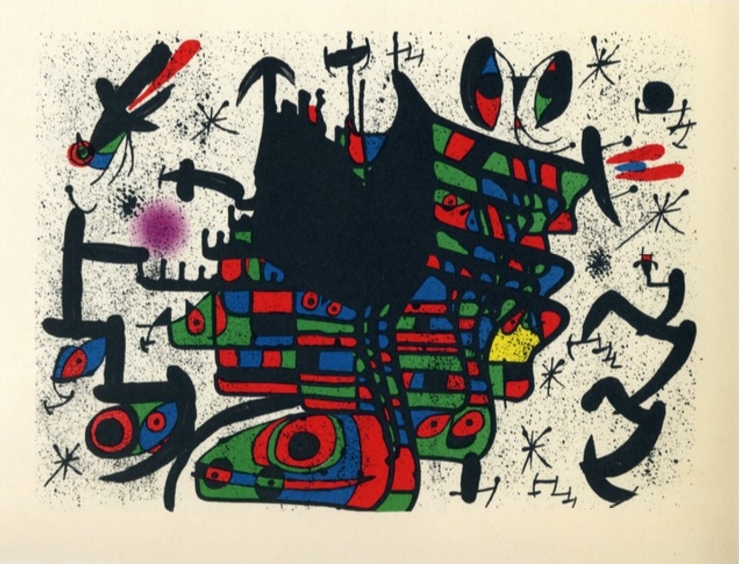
HOMENATGE A JOAN PRATS # 13,
1971
Lithograph
Dimensions: 75
× 100 cm
© 2016 Successió Miró / Artists Rights Society (ARS), New York / ADAGP, Paris


PEINTURE 10, 1941
Oil and
Pencil on Masonite
Dimensions: 14
× 77.8 cm
© 2016
Successió Miró / Artists Rights Society (ARS), New York / ADAGP, Paris


QUATRE COLORS APARIEN EL MON: SHEET
1, 1975
Original
Color Etching, Aquatint, and Embossing on Arches Wove Paper
Dimensions: 88.9
× 63.5 cm
© 2016 Successió Miró / Artists Rights Society (ARS), New York / ADAGP, Paris

PAINTING: THE FRATELLINI
BROTHERS 1927
Oil on Canvas
Dimensions: 130
× 97.5 cm
Photo: Robert
Bayer, Basel / © Successió Miró /
Artists
Rights Society (ARS), New York / ADAGP

GRAND TRIPTYQUE NOIR, 1969
Etching, Aquatint
and Carborundum in Colors
Dimensions: 159
× 118 cm
© 2016 Successió Miró / Artists Rights Society (ARS), New York / ADAGP, Paris

THE ESCAPE
LADDER 1940
Gouache,
Watercolor, and Ink on Paper
Dimensions:
40.0 x 47.6 cm
Credit Line: Helen Acheson Bequest


HEAD, BIRD,
1977
Indian Ink,
Lithographic Ink Tempera
And Wax on
Paper - 39 3/8 X 27 3/8 in.
Museo Nacional Centro de Arte Reina Sofia, © Successio Miró /
Artists Rights Society (ARS), New York, ADAGP, Paris, 2014


PERSONAGES IN THE NIGHT 1950
Oil on Canvas
Scala / Art
Resource, NY / Miro, Joan (1893-1983) © ARS, NY
Private Collection, New York


BECLOUDED
PERSON 1955
Lithograph
Dimensions:
Composition: 75.6 x 55.3 cm; Sheet: 76.1 x 56 cm
Credit Line:
Larry Aldrich Fund
© 2014 Successió Miró / Artists Rights Society (ARS), New York / ADAGP, Paris

CONSTELLATIONS 1959
Etching on
Arches Vellum
Dimensions: 45
× 36 cm
© 2016 Successió Miró / Artists Rights Society (ARS), New York / ADAGP, Paris


WOMAN OF THE SANDS 1969
Original
Etching, Aquatint and Carborundum
Dimensions: 104.8
× 66.7 cm
© 2016
Successió Miró / Artists Rights Society (ARS), New York / ADAGP, Paris
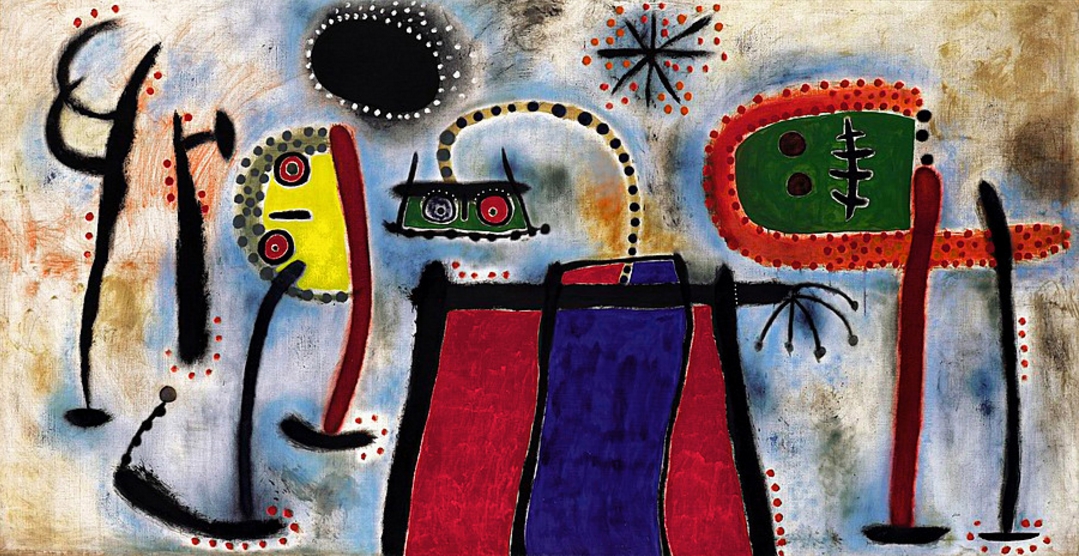
PAINTING 1953
Oil on Canvas
Dimensions: 194.9
x 377.8 cm
Credit Line:
Solomon R. Guggenheim Museum, New York
2016 Successió Miró / Artists Rights Society (ARS), New York / ADAGP, Paris
In 1925 Miró’s work took a decisive
turn, stimulated, according to the artist, by hunger-induced hallucinations
involving his impressions of poetry. These resulted in the artist’s “dream
paintings,” such as Personage, in which ghostly figures hover in a
bluish ether. Miró explored Surrealist automatism in these canvases, attempting
to freely transcribe his wandering imagination without preconceived notions.
Although these images are highly schematic, they are not without references to
real things, as the artist made clear. “For me a form is never something
abstract,” he said in 1948. “It is always a sign of something. It is always a
man, a bird, or something else.” In these works Miró began to develop his own
language of enigmatic signs: the forms in Personage depict a large
vestigial foot and a head with three “teeth” in its grinning mouth. The star
shape often represents female genitalia in Miró’s oeuvre, and the dot with four
rays symbolizes the vision of a disembodied eye.
Two years later Miró reverted to
imagery somewhat more grounded in reality. In Landscape (The Hare),
among other works, he also returned to one of his favorite subjects, the
countryside around his family’s home in Catalonia. Miró said that he was
inspired to paint this canvas when he saw a hare dart across a field on a
summer evening. In Landscape (The Hare), this event has been transformed
to emphasize the unfolding of a heavenly event. A primeval terrain of acid
oranges and red is the landscape in which a hare with bulging eyes stares transfixed
by a spiraling “comet.”
By the late 1940s Miró was making
canvases on a much larger scale and with broader
markings. Painting of 1953 is more than 6 feet high by 12 feet wide
and is characterized by loose, gestural brushstrokes and stained pigments. The
calligraphic drawing style and open field of works such
as Personage has, in Painting, metamorphosed into bold,
energetic lines in a vast, cosmic atmosphere. Yet the star and sun, the
animal-like forms, and the sprays of dots are signs of the artist’s symbolic
language developed in the 1920s.
Jennifer Blessing
http://www.guggenheim.org/new-york/collections/collection-online/artwork/2944

SANS TITRE I, 1970
Dimensions: 29
× 78 cm
© 2016 Successió Miró / Artists Rights Society (ARS), New York / ADAGP, Paris

UNTITLED – FROM BARCELONA SUITE
M. 598, 1972
Carborundum
Etching
Dimensions: 105.4
× 69.9 cm
© 2016 Successió Miró / Artists Rights Society (ARS), New York / ADAGP, Paris

Galerie
Maeght, 13 rue de Teheran, Miró, l'oiseau solaire, l'oiseau lunaire, étincelles
Lithograph
- Dimensions: 64.3 x 47.8 cm
Credit Line:
Peter Stone Collection of Posters by Artists
© 2014 Successió Miró / Artists Rights Society (ARS), New York / ADAGP, Paris


Galerie
Maeght, Miró Artigas, Ceramiques Monumentales
Lithograph
Dimensions:
66.9 x 49.7 cm
Credit Line:
Peter Stone Collection of Posters by Artists
© 2014
Successió Miró / Artists Rights Society (ARS),
New York / ADAGP, Paris

WOMEN AND BIRD IN THE MOONLIGHT
1949
Oil paint on
Canvas
Dimensions: 81.3
× 66 cm
Erich Lessing
/ Art Resource, NY / © Successió Miró /
Artists
Rights Society (ARS), New York / ADAGP, Paris
Tate Gallery, London


DUTCH
INTERIOR II, 1928
Oil on Canvas
Dimensions: 92
x 73 cm
Credit Line:
The Solomon R. Guggenheim Foundation
Peggy
Guggenheim Collection, Venice, 1976
2016 Successió Miró/Artists Rights Society (ARS), New York/ADAGP, Paris

SOURIS NOIRE A LA MANTILLA
1976
Color
Aquatint
Dimensions: 114.5
× 74 cm
© 2016 Successió Miró / Artists Rights Society (ARS), New York / ADAGP, Paris

PAINTING 5 –
1941 / 1974
Dimension: 13,5
x 53,8 cm

UNTITLED 1973
Lithograph
Dimensions:
Sheet and Comp. 89.8 x 61.0 cm
Credit
Line: Gift of the Museum Department of Publications
© 2014 Successió Miró / Artists Rights Society (ARS), New York / ADAGP, Paris

THE WALL OF THE MOON, CA. 1957
Color
Lithograph
Dimensions: 23.2
× 74.6 cm
© Successió
Miró / Artists Rights Society (ARS), New York / ADAGP, Paris


THE JOAN MIRÓ FOUNDATION
The Joan Miró
Foundation opened to the public on 10 June 1975. It had its origins in Miró's
first large exhibition in Barcelona, in 1968, at the Antic Hospital de la Santa
Creu. Several figures from the world of the arts saw the opportunity to have a
space in Barcelona dedicated to the artist's work. However, in accordance with
his wishes, the new institution was also to promote and publicise the work of
contemporary artists in all its aspects.At a time when artistic and cultural
life was certainly minimal, the Foundation brought a refreshing vitality,
together with a new, more dynamic concept of an art museum in which Miró's art
was shown alongside a wide variety of creative works by other artists - a fact
that is reflected in the Foundation's full name of Centre for the Study of Contemporary
Art.
http://www.fundaciomiro-bcn.org/fundaciojoanmiro.php?idioma=2


THE FOUNDATION BUILDING
The Foundation building was designed by Josep Lluís Sert, architect, co-founder
of the GATCPAC (Grup d'Arquitectes i Tècnics Catalans per al Progrés de l'Arquitectura
Contemporània) and a close friend of Joan Miró. It was built on land provided
by the City Council in the Parc de Montjuïc.
Towards the end of the 1960s, Sert and Miró began working on the idea of a
"Miró Museum" on the site. From the outset, the Foundation was
designed in accordance with the principles of Rationalist architecture, with
different spaces set around a central patio in the traditional Mediterranean
style and with Sert's characteristic skylights. Designed to house the Miró
collection, more than thirty years after it was opened the building has also
demonstrated its capacity and adaptability for displaying the work of other
artists of the twentieth and twenty-first centuries and continues to be an
emblematic example of contemporary architecture.
In 1988 it was enlarged so as to gain more exhibition space, provide room for
new services and relocate the offices. The extension was designed by Jaume
Freixa, a friend and pupil of Sert.
http://www.fundaciomiro-bcn.org/fundacio_edifici.php?idioma=2


THE GOLD OF
THE AZURE 1967
Dimension:
205 x 173 cm

FIGURE,DOG,BIRDS
1946
Gouache and
Watercolor on Paper
Dimensions: 21
x 31.1 cm
Credit Line:
Solomon R.
Guggenheim Museum, New York Gift, Andrew Powie Fuller and
Geraldine
Spreckels Fuller Collection, 1999

PLATE XXII
FROM THE BARCELONA SERIES 1944
Lithograph
Dimensions:Composition:
61.9 x 47.3cm; Sheet: 70 x 52.2 cm
Edition 5
© 2016
Successió Miró / Artists Rights Society (ARS), New York / ADAGP, Paris


DAWN PERFUMED BY A SHOWER OF
GOLD 1954
Watercolor
and Plaster on Composition Board
Dimensions: 108
× 54.3 cm
© Successió
Miró / Artists Rights Society (ARS), New York / ADAGP, Paris


TITLE PAGE
FROM ALBUM 13 - 1948
Lithograph
© 2014
Successió Miró / Artists Rights Society (ARS),


POSTER FOR
INTERNATIONAL EXHIBITION OF SURREALIZM 1947
Lithograph
Dimensions:
Composition: 51.3 x 43.8 cm; Sheet: 64.5 x 46.6 cm


WOMAN AND
CHILD 1969
Dimension: 61
x 50,1 cm


WOMEN, BIRDS
1973
Dimension: 302
x 257 cm


PAINTING 1933
Oil on Canvas
Dimensions: 130.5
× 162.9 cm
Wadsworth
Atheneum Museum of Art / Art Resource, NY /
Miro, Joan
(1893-1983) © ARS, NY

LA CALEBASSE 1969 ( DETAIL )

LA CALEBASSE 1969
Color
Etching, Aquatint and Carborundum
Dimensions: 90
× 61 cm


THE MUSIC -
HALL USHER 1925
Dimension: 100
x 78 cm

SOBRETEIXIM
17 - 1973
Acrylic, Felt and Piece of Plastic Bucket on
Wall-Hanging Woven by Josep Royo
Dimension: 143
x 230 cm

WOMAN
ENCIRCLED BY A FLIGHT OF BIRDS IN THE NIGHT 1968
Acrylic on tarpaulin (used for the grape harvest)
Dimension:
336 x 336 cm

48 FROM THE PRINTS OF JOAN MIRO
PORTFOLIO 1947
Etching on
Auvergne Paper
Dimensions: 28
× 22 cm
© 2016 Successió Miró /
Artists Rights Society (ARS), New York / ADAGP, Paris

PERSONNAGE 1970
Photo:
Olivier Middendorp


PERSONNAGE 1967
Photo:
Olivier Middendorp


WOMAN, BIRDS
1973
Dimension: 80
x 65 cm


UNTITLED FROM LE LEZARD AUX
PLUMES D’OR, 1971
From the
Series A Superb Impression of the Definitive State, From the Album
Edition of 195 ( Apart From the Pencil-Signed and Numbered Deluxe Edition). One
of Fifteen Color Lithographs Illustrating the Text Le Lezard Aux Plumes d’Or, a
Series of the Artist’s Own Poems. Published by Louis Broder, Paris; Printed at
Atelier Fernand Mourlot, Paris.
Original
Lithograph Printed in Colors on Rives Wove Paper Bearing the Miró Watermark.
Dimensions: 35.4
× 100 cm


THE FLIGHT OF
A BIRD OVER THE PLAIN III, 1939
Oil on Urlap
Dimensions: 89.5
x 115.6 cm
Credit Line:
Solomon R.
Guggenheim Museum, New York Gift, Evelyn Sharp, 1977


JOAN MIRÓ
2.
INFLUENCE AND POSTHUMOUS REPUTATION
The large retrospectives
devoted to Miró in his old age in towns such as New York (1972), London (1972),
Saint-Paul-de-Vence (1973) and Paris (1974) were a good indication of the
international acclaim that had grown steadily over the previous half-century;
further major retrospectives took place posthumously. Political changes in his
native country led in 1978 to the first full exhibition of his painting and
graphic work, at the Museo Español de Arte Contemporáneo in Madrid. The
Fundació Joan Miró was inaugurated in Barcelona in 1975 in a building designed
by his friend Josep Lluís Sert, housing a large number of paintings, drawings,
sculptures and prints donated by the artist. In 1992, in accordance with the
wishes expressed by the artist, the Fundació Pilar i Joan Miró was inaugurated
in Palma de Mallorca; it has its headquarters in the studios of Son Abrines i
Son Boter, where he used to work but in a new building designed by the
architect Rafael Moneo. In 1993, the year of the hundredth anniversary of his
birth, several exhibitions were held, among which the most prominent were those
held in the Fundació Pilar i Joan Miró, Barcelona, the Museum of Modern Art,
New York, the Centro de la Reina Sofia, Madrid, and the Galerie Lelong, Paris.
José Corredor-Matheos
From Grove Art Online
© 2009 Oxford University
Press
http://www.moma.org/collection/browse_results.php?criteria=O%3AAD%3AE%3A4016&page_number=1&template_id=6&sort_order=1§ion_id=T058580#skipToContent


.jpeg)


