May 25, 2014

JEAN COCTEAU MUSEUM DESIGN BY RUDY RICCIOTTI


JEAN COCTEAU MUSEUM DESIGN BY RUDY RICCIOTTI


JEAN COCTEAU MUSEUM DESIGN BY RUDY RICCIOTTI

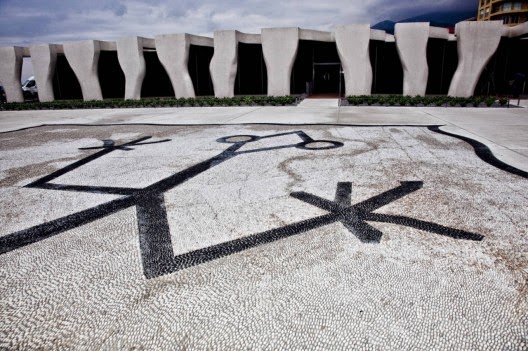
Selected in 2008 as the winning design from an international field of entries in a competition launched by the town Menton in 2007, the architectural project of Rudy Ricciotti, the 2006 winner of France’s Gran Prix National d’Architecture, covers a total area of 2,700 sqm able to house all of the works donated by Severin Wunderman.

Although limited in some aspects, the site has great potential. Its features include a pre-existing parking garage on the first subterranean level and a purification plant on the second subterranean level with their access ramps bisecting the site, a sea-level aquifer, backfill soil, sea spray exposure, etc. Stresses in the immediate vicinity include a noisy coastal urban thorough fare.

The site is also not neutral in its impact. It will strengthen the relationship between the town’s centre and its seafront, as substructure ensuring the resilience of the existing urban landscape. The building must be in keeping with Menton’s urban fabric and character, helping to return the Quai Monléon to pedestrian use. Setting aside the disquieting vision of the archways, depicted in old picture postcards, the virtues of Menton as a seaside resort must be retained.

Photographs: Agence Rudy Ricciotti, Lisa Ricciotti, Olivier Amsellem

http://www.archdaily.com/225487/jean-cocteau-museum-rudy-ricciotti/


http://www.rudyricciotti.com/musees/musee-jean-cocteau--collection-severin-wunderman#!2


‘’ The choice of architectural materials for this project, and especially its black-and‐white aesthetic, was unavoidable. The realm of dreams and mystery, the starkness of contrasts and the interweaving of shadows ultimately reflect the contradictions in Cocteau's life and work.

Black and white no longer serve as colors here. Rather, they create an interplay of structural forces calling to mind both the artist's works on paper and the poet's personality, his zones of light and darkness, his enigmatic self-mythology fueled by contrasts. ‘’

Rudy Riccotti


RUDY RICCIOTTI

Born August 22, 1952 in Algiers, Algeria.

Diplomas

1980 – School of Architecture Marseille, France
1975 – Higher Technical School of Geneva, Switzerland

Architect and engineer, awarded the Grand prix National d’Architecture in 2006 and the Médaille d’or de l’Académie d’architecture, Rudy Ricciotti is representative of this generation of architects who combine the power of creation with a genuine culture of construction.
Pioneer and ambassador of concrete, he sublimates innovative uses of concrete in landmark projects such as the Vitrolles Stadium – 1994, the National Choreographic Center – the Black Pavilion in Aix-en-Provence – 2006, the Jean Cocteau Museum in Menton – 2011, the Department of Islamic Arts at the Louvre Museum – 2012, the MuCEM (Museum of European and Mediterranean Civilizations) in Marseille – 2013, the Jean Bouin Stadium in Paris – 2013, the Bridge of the Republic in Montpellier – 2014, the Camp de Rivesaltes Memorial – 2015, or the Bordeaux Métropole Arena and parking in Floirac – 2017, the Humanist Library at Sélestat – 2018, the Regional Found of Contemporary Art Normandie-Caen – 2019, the Contemporary and Contemporary Music-Hall in Aix-en-Provence – 2019, the Nantes Train station – 2020.

He has also constructed abroad, the Philharmonie Nikolaisaal in Potsdam, Germany – 2000, the Peace Bridge in Seoul, South Korea – 2002, and the CIAC “La Boverie” (International Center of Art and Culture) in Liège, Belgium – 2016.

Rudy Ricciotti is also the author of numerous books and pamphlets, including Le Beau, le brut et les truands (conversation with Paul Chemetov) published by Textuel – 2021, Premières lignes published by Cassis Belli – 2019, L’exil de la beauté published by Textuel – 2019, Je te ressers un pastis ? published by l’Aube – 2019, Mémorial du Camp de Rivesaltes published by Archibooks – 2016, Le béton en garde à vue published by Lemieux Éditeur – 2015, En vain published by Jannink – 2014, Conversations imaginaires “ou pas” published by un autre Reg’Art – 2014, L’architecture est un sport de combat published by Textuel – 2013, HQE published by Le Gac Press – 2013.

https://rudyricciotti.com/en/biography/


May 22, 2014

JULIAN SCHNABEL AT GAGOSİAN GALLERY NEW YORK


JULIAN SCHNABEL AT GAGOSIAN GALLERY NEW YORK
VIEW OF DAWN IN THE TROPICS: PAINTINGS, 1989–1990
April 17, 2014 – May 31, 2014


JULIAN SCHNABEL AT GAGOSIAN GALLERY NEW YORK
VIEW OF DAWN IN THE TROPICS: PAINTINGS, 1989–1990
April 17, 2014 – May 31, 2014
‘’ A lot of what I do is about being in the moment…The residue of what happens; that's what's in the paintings. ‘’
                                                                                                                              Julian Schnabel
Gagosian is pleased to present “View of Dawn in the Tropics: Paintings, 1989–1990,” an exhibition of paintings by Julian Schnabel that are being shown in New York for the first time, twenty-five years after they were made.
In the late 1980s and early 1990s, Schnabel approached painting as an act as susceptible to chance and circumstance as life itself. Working in the wake of American antecedents such as Robert Rauschenberg and Cy Twombly—who brought a certain sense of freedom to bear on their evident romance with European art and aesthetics—Schnabel made audaciously scaled paintings and sculptures whose richly hybrid sources were expressed in an attitude of baroque excess combined with improvisational daring. Broken plates, Kabuki theater backdrops, tarpaulins and boxing mats; thickly applied oil paint, collage, viscous resin, and flat digital reproduction; fragments of text in different languages: these are just some of the diverse materials with which Schnabel engages life's grand themes—sexuality, obsession, suffering, redemption, death, and belief.
For Paintings With and Without Bingo and Ozymandias, executed en plain air on the site of a ruined neoclassical building during a sojourn in Florida, Schnabel used old tarpaulins, sailcloth, and rolls of velvet as grounds on which to render reflections of his immediate surroundings subject to uncontrollable forces, from tropical storms to his dog Bingo's seemingly random but deliberate paw prints. These paintings, and others made in similarly unorthodox conditions in Montauk and San Sebastian, reveal an individualistic interplay between site and mark-making, both intentional and incidental, that eschews pictorial hierarchies of authorship, subject, and style.
Schnabel’s persistent allegiance and magnanimous, catch-all approach to painting attests to the palimpsest of emotion, memory, and chance that drives a gleaner's relationship to material and image: from collected words and phrases to allusions to specific moments, places, friends, and family, and narratives of surface, materiality, and studio process. These visceral paintings—where velvet is drenched in sea water, or tablecloths are doused in paint and used as sponges on visibly patched tarpaulins—embody an alternative, iconoclastic approach to “the sacred cloth,” shared with the aforementioned American forbears, as well as kindred spirits Francis Picabia, Yves Klein, Alberto Burri, and Sigmar Polke, to name but a few. There is no substitute for the authenticity of Schnabel's gesture; twenty-five years after their making, his elegant yet exuberant and intrepid paintings have renewed vigor and urgency, anticipating the gestural, aleatory, and readymade painting so pervasive among emerging artists today.
JULIAN SCHNABEL
Julian Schnabel was born in New York City in 1951 and studied at the University of Houston (1969–73) and the Whitney Museum Independent Study Program (1973–74). Public collections include Metropolitan Museum of Art, New York; Museum of Modern Art, New York; Whitney Museum of American Art, New York; Solomon R. Guggenheim Museum, New York; Museum of Contemporary Art, Los Angeles; Broad Art Foundation, Los Angeles; National Gallery of Art, Washington, D.C.; Tate Gallery, London; Centre Georges Pompidou, Paris; and Museo Nacional Centro de Arte Reina Sofía, Madrid. Recent solo exhibitions include Inverleith House, Edinburgh (2003); Schirn Kunsthalle, Frankfurt (2004); Museo Nacional Centro de Arte Reina Sofía, Madrid (2004); Mostra d'Oltramare, Naples (2005); Schloss Derneburg, Germany (2007); Tabacalera Donostia, San Sebastian, Spain (2007); Beijing World Art Museum (2007); Saatchi Gallery, London (2008); Art Gallery of Ontario (2010); Museo Correr, Venice (2011); Centro Italiano Arte Contemporanea, Foligno, Italy (2013); and Brant Foundation Art Study Center (2013–14).
“Julian Schnabel: An Artist Has A Past (Puffy Clouds and Strong Cocktails),” an exhibition of fifteen paintings produced over the past decade, will be on view at Dallas Contemporary from April 11–August 10, 2014.
Draw a Family, a fully illustrated book focusing on Schnabel's paintings of the past forty years, was published by Karma in April of 2014.
Schnabel lives and works in New York City and Montauk.


UNTITLED ( LOS PATOS DEL BUEN RETIRO IV ) 1991
Oil, Gesso on Velvet, 180 x 180"
Copyright 2014 Julian Schnabel All Rights Reserved
designed by Julian Schnabel Studio 


"JULIAN SCHNABEL: VIEW OF DAWN IN THE TROPICS:
PAINTINGS, 1989–1990" INSTALLATION VIEW
© 2014 Julian Schnabel/Artists Rights Society (ARS), New York
​Photo by Rob McKeever


"JULIAN SCHNABEL: VIEW OF DAWN IN THE TROPICS:
PAINTINGS, 1989–1990" INSTALLATION VIEW
© 2014 Julian Schnabel/Artists Rights Society (ARS), New York
​Photo by Rob McKeever


UNTITLED ( LOS PATOS DEL BUEN RETIRO II ) 1991
Oil, Gesso on Velvet, 180 x 180"
Copyright 2014 Julian Schnabel All Rights Reserved
designed by Julian Schnabel Studio


UNTITLED ( LOS PATOS DEL BUEN RETIRO I ) 1991
Oil, Gesso, Resin on Velvet, 180 x 190"
Copyright 2014 Julian Schnabel All Rights Reserved
designed by Julian Schnabel Studio


A LITTLE LATER 1990
Oil, gesso on white tarp - 243.8 x 193 cm
Photo by Rob McKeever


"JULIAN SCHNABEL: VIEW OF DAWN IN THE TROPICS:
PAINTINGS, 1989–1990" INSTALLATION VIEW
© 2014 Julian Schnabel/Artists Rights Society (ARS), New York
​Photo by Rob McKeever


UNTITLED 1990
Resin, gesso on burlap - 304.8 x 274.3 cm
Photo by Ken Cohen Photography


"JULIAN SCHNABEL: VIEW OF DAWN IN THE TROPICS:
PAINTINGS, 1989–1990" INSTALLATION VIEW
© 2014 Julian Schnabel/Artists Rights Society (ARS), New York
​Photo by Rob McKeever


"JULIAN SCHNABEL: VIEW OF DAWN IN THE TROPICS:
PAINTINGS, 1989–1990" INSTALLATION VIEW
© 2014 Julian Schnabel/Artists Rights Society (ARS), New York
​Photo by Rob McKeever


UNTITLED (LOS PATOS DEL BUEN RETIRO V) 1991
Oil, Gesso on Velvet, 180 x 180"
Copyright 2014 Julian Schnabel All Rights Reserved
designed by Julian Schnabel Studio 


GAGOSIAN GALLERY 


LARRY GAGOSIAN 


GAGOSIAN GALLERY - LARRY GAGOSIAN


GAGOSIAN GALLERY 


UNTITLED 1990
Resin, gesso on burlap - 304.8 x 274.3 cm
Photo by Ken Cohen Photography


"JULIAN SCHNABEL: VIEW OF DAWN IN THE TROPICS:
PAINTINGS, 1989–1990" INSTALLATION VIEW
© 2014 Julian Schnabel/Artists Rights Society (ARS), New York
​Photo by Rob McKeever


UNTITLED 1990
Resin, gesso on burlap - 304.8 x 274.3 cm
Photo by Ken Cohen Photography


"JULIAN SCHNABEL: VIEW OF DAWN IN THE TROPICS:
PAINTINGS, 1989–1990" INSTALLATION VIEW
© 2014 Julian Schnabel/Artists Rights Society (ARS), New York
​Photo by Rob McKeever


MR. SCHNABEL’ "UNTITLED" 2013
Credit 2014 Julian Schnabel/Artists Rights Society (ARS),
New York and Karma, New York


UNTITLED (CHRIST’LAST DAY ) VII, 2007
Ink on polyester - 421.6 × 254 cm
© Julian Schnabel


LOLA 1989
Oil and gesso on velvet - 274.3 × 304.8 cm
© Julian Schnabel/ Artists Rights Society (ARS), New York


"JULIAN SCHNABEL: VIEW OF DAWN IN THE TROPICS:
PAINTINGS, 1989–1990" INSTALLATION VIEW
© 2014 Julian Schnabel/Artists Rights Society (ARS), New York
​Photo by Rob McKeever


THE DAY I MISSED 1990 ( DETAIL )


THE DAY I MISSED 1990
Oil, Gesso on White Tarp 243,8 * 193 cm
Copyright 2014 Julian Schnabel All Rights Reserved
designed by Julian Schnabel Studio


THE DAY I MISSED 1990 ( DETAIL )


FOX FARM PAINTING III - 1989
Oil, Gesso on Velvet, 120 X 96"
Copyright 2014 Julian Schnabel All Rights Reserved
Designed by Julian Schnabel Studio


FOX FARM PAINTING VIII - 1989
Oil, Gesso Marker on Velvet,, 120 X 180"
Copyright 2014 Julian Schnabel All Rights Reserved
designed by Julian Schnabel Studio


 JULIAN SCHNABEL