

ANTONY GORMLEY: EXPANSION FIELD AT ZENTRUM PAUL KLEE
September 09, 2014 - January 11, 2015

ANTONY
GORMLEY: EXPANSION FIELD AT ZENTRUM PAUL KLEE
September 09,
2014 - January 11, 2015
Antony
Gormley’s EXPANSION FIELD is being presented for the first time in the large
exhibition hall at the Zentrum Paul Klee. This new work, consisting of 60
individual sculptures fabricated from Corten steel, is derived directly from
different postures of the human body. The rigorous conceptual basis of this
work and its disciplined spatial arrangement engage the viewer in a first-hand
experience of space and time, while drawing on references from prehistory, to
Minimal and Body Art. The orthogonal field provides a strong counterpoint to
the ZPK and Renzo Piano’s organic architectural structure.
EXPANSION
FIELD is a continuation of the various "Field" works made throughout
Gormley’s working life, including EUROPEAN FIELD and ASIAN FIELD, where tens of
thousands of tiny clay figures occupy an indoor space; or in fields which
cannot be understood at first sight, such as HORIZON FIELD in Bregenzer Wald,
where a number of life-sized figures placed at the same height above sea level
occupy an area of over 150 square kilometres.
These works
are derived from captured moments of lived time that on the one hand can be
associated with Body and Performance Art, and on the other, EXPANSION FIELD can
be seen in relation to prehistoric monuments such as the Megalithic avenues of
Carnac in Brittany and as a comment on the urban grid of Manhattan. EXPANSION
FIELD has a strong affinity with the serial works of Donald Judd, including his
monumental installation at Marfa in Texas, or with The Lightning Field of
Walter
De Maria. It
re-examines the language of Cubism while continuing the demands of engagement
made by Minimal Art.
EXPANSION
FIELD could be seen as predestined as an installation at the Zentrum Paul Klee,
since the work contrasts in an exciting way with the organic language of Renzo
Piano’s architecture while rich in its points of contact with the universe of
Paul Klee. Both artists are interested in the connections and interchange
between the evolution of nature and constructed realities.
Three early
sculptures by the artist that engage with expansion and create a dialogue
between growth, space and seriality are being exhibited in a cabinet alongside
the spatial installation EXPANSION FIELD.
Curated by
Peter Fischer, curatorial assistance Simone Küng. A catalogue of the exhibition
will be published in November 2014.
Supported by
Die Mobiliar, JTI, Stanley Thomas Johnson Foundation.
You may reach Antony Gormley’s interview with Pierre Tillet and past exhibitions
news at Gallery Andersson Stockholm, White Cube Gallery Hong Kong,
Xavier Hufkens Gallery and Middelheim Museum to click below links.
http://mymagicalattic.blogspot.com.tr/2014/09/antony-gormley-meet-at-gallery.html
http://mymagicalattic.blogspot.com.tr/2013/12/british-artist-antony-gormley.html
http://mymagicalattic.blogspot.com.tr/2014/04/antony-gormley-states-conditions-at.html

ANTONY GORMLEY: EXPANSION FIELD, 2014
60 Sculptures in Corten Steel
Installation, Zentrum Paul Klee © Antony Gormley
Photo: Dominique Uldry


ANTONY GORMLEY: EXPANSION FIELD, 2014
60 Sculptures in Corten Steel
Installation, Zentrum Paul Klee © Antony Gormley
Photo: Dominique Uldry


ANTONY GORMLEY'S STUDIO


ANTONY GORMLEY: EXPANSION FIELD, 2014
60 Sculptures in Corten Steel
Installation, Zentrum Paul Klee © Antony Gormley
Photo: Maria Horst

ZENTRUM PAUL KLEE

ZENTRUM PAUL KLEE
With around 4'000 works at its disposal the Zentrum Paul
Klee has the most significant collection of paintings, aquarelles and drawings
world-wide and includes archive and biographical material from all the periods
of Paul Klee’s work.
A principal task of the Zentrum Paul Klee is to ensure that
the artistic, pedagogic and theoretical work of Paul Klee as well as its
significance within the cultural and social context of its time, is
scientifically developed and communicated through different channels and media.
By posing topical questions, new scientific interpretations
and innovative forms of communication, the Zentrum Paul Klee aims to bring Paul
Klee’s artistic potential into the present.
Visitors are able to gather stimulating experiences and
discoveries. This should motivate to a more intense understanding of Klee’s
work and personality, artistic insight in general and to each individual’s
cultural life.
Through its activities the Zentrum Paul Klee is established
as the competence centre worldwide for the research and the communication of
the life and work of Paul Klee, the history of its effect and other culturally
relevant themes. It maintains an efficient and modern research infrastructure
and develops distinctive proposals for exhibition and communication programmes,
in accordance with scientific demands as well as the expectations of visitors
of different age groups, biographical backgrounds and cultural interests.
For this purpose
- Rooms of high aesthetic and functional quality for the
presentation of temporary exhibitions are available,
- The open and public accessible zone of the Museumsstrasse
encourages a critical look at art by means of various media as well as the
encounter between art and art enthusiasts,
- A generously conceived activity area for children, young
people and adults encourages the development of their own creativity,
- An auditorium with ideal conditions for musical
experiences is maintained,
- Modern equipped rooms for events and seminars are
available to deal with themes on subject matter from the most varied areas of
culture, science and business,
- The building designed by architect Renzo Piano and its
surroundings offer a unique symbiosis of nature and culture.
The Zentrum Paul Klee was made possible through the founder
families Klee and Müller, the authorities and the sovereign power of the City,
the Canton and Burgergemeinde Bern as well as partners from business.
The concrete activities of the Zentrum Paul Klee are derived
from the statutes of the Foundation of the Zentrum Paul Klee and are orientated
toward realising the subsidy agreement with the Canton Berne, the City of Berne
and the communities of the Regional Conference of Bern-Mittelland, the
guidelines of the International Council of Museums ICOM as well as internal
business regulations. As an institution, only partially supported by public
funds, the Zentrum Paul Klee adheres in its business activities, especially in
the declaration of accounts, to the imperative principles of transparency and submits
to regular controls through the subsidisers.
http://www.zpk.org/en/service-navigation/about-us/concept-104.html


RENZO PIANO


ZENTRUM PAUL KLEE


ANTONY GORMLEY: EXPANSION FIELD, 2014
60 Sculptures in Corten Steel
Installation, Zentrum Paul Klee © Antony Gormley
Photo: Maria Horst

ANTONY GORMLEY'S STUDIO


STATEMENT BY ANTONY GORMLEY
EXPANSION FIELD: body and space mediated through architecture.
Over the years, my obsession has been to try to explore the body as a place rather than simply as an object and to reconcile its space with space at large. I want to acknowledge that while we live within a built environment and we are the only animal to construct a habitat using Euclidean principles, the moment we close our eyes and become conscious of the darkness of the body, we are in an unbounded,
ever extending space without dimension. This intimate zone of experience has the same unlimited properties as the sky at night.
With this Expansion Field, the cosmological constant of an expanding universe is applied to the subjective space of the body. The work is comprised of 60 boxes that evoke the unstable place of the body as an architectural field: 60 cases for darkness, or night, each derived from the volumes of my body but translated into the geometry of architecture.
Fabricated in Corten steel and hermetically welded, the sculptures are absolute displacements of space; volumes of night placed in light. They are made from up to thirty different body positions that have each been expanded as many as six times, and the resulting expansions are orientated in all directions. The incremental expansion of these body zones is random but they are placed on a clear grid, through which the body of the viewer is invited to wander.
This is a reflective field in which subjective experience is catalysed by voided objects. The degree to which it encourages projection is the degree to which it encourages proprioception.
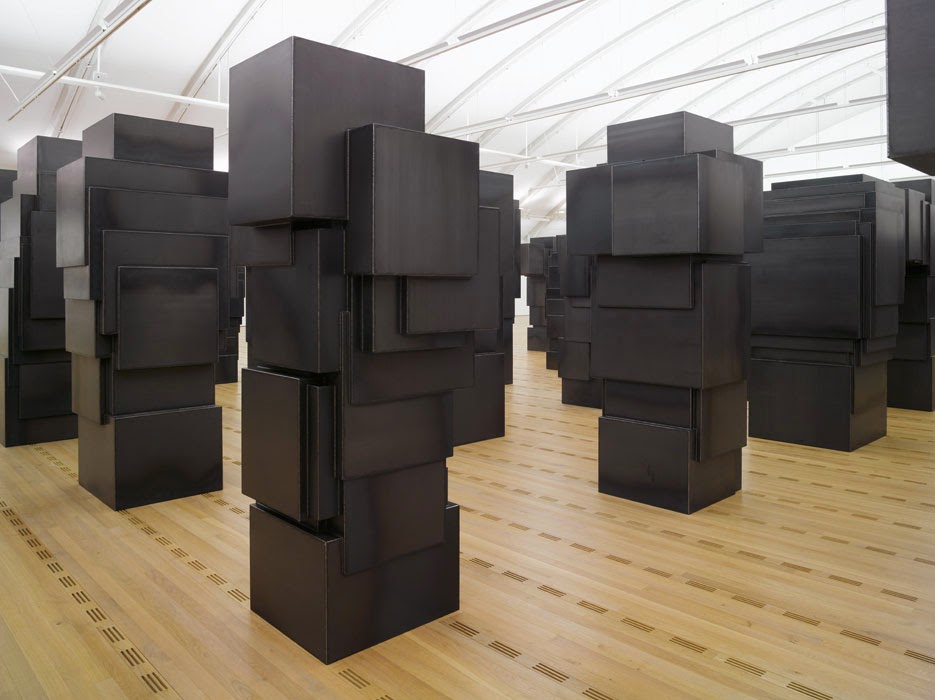
ANTONY GORMLEY: EXPANSION FIELD, 2014
60 Sculptures in Corten Steel
Installation, Zentrum Paul Klee © Antony Gormley
Photo: Dominique Uldry

ANTONY GORMLEY: EXPANSION FIELD, 2014
60 Sculptures in Corten Steel
Installation, Zentrum Paul Klee © Antony Gormley
Photo: Dominique Uldry


ANTONY GORMLEY: EXPANSION FIELD, 2014
60 Sculptures in Corten Steel
Installation, Zentrum Paul Klee © Antony Gormley
Photo: Dominique Uldry


ANTHONY
GORMLEY
Antony
Gormley is widely acclaimed for his sculptures, installations and public
artworks that investigate the relationship of the human body to space. His work
has developed the potential opened up by sculpture since the 1960s through a
critical engagement with both his own body and those of others in a way that
confronts fundamental questions of where human being stands in relation to
nature and the cosmos. Gormley continually tries to identify the space of art
as a place of becoming in which new behaviours, thoughts and feelings can
arise. Gormley's work has been widely exhibited throughout the UK and
internationally with exhibitions at Centro Cultural Banco do Brasil, São Paulo,
Rio di Janeiro and Brasilia (2012); Deichtorhallen, Hamburg (2012); The State
Hermitage Museum, St Petersburg (2011); Kunsthaus Bregenz, Austria (2010);
Hayward Gallery, London (2007); Malmö Konsthall, Sweden (1993) and Louisiana
Museum of Modern Art, Humlebæk, Denmark (1989). He has also participated in
major group shows such as the Venice Biennale (1982 and 1986) and Documenta 8,
Kassel, Germany (1987). Permanent public works include the Angel of the North
(Gateshead, England), Another Place (Crosby Beach, England), Inside Australia
(Lake Ballard, Western Australia) and Exposure (Lelystad, The Netherlands).
Gormley was awarded the Turner Prize in 1994, the South Bank Prize for Visual
Art in 1999 and the Bernhard Heiliger Award for Sculpture in 2007. In 1997 he
was made an Officer of the British Empire (OBE). He is an Honorary Fellow of
the Royal Institute of British Architects, an Honorary Doctor of the University
of Cambridge and a Fellow of Trinity and Jesus Colleges, Cambridge. Gormley has
been a Royal Academician since 2003 and a British Museum Trustee since 2007.
Antony Gormley was born in London in 1950.


